Views: 0 Author: Site Editor Publish Time: 2026-01-16 Origin: Site


A warehouse robot waiting on a charge is a robot that is not moving totes, so charging architecture in an automated facility is a throughput question rather than a battery question. This analysis breaks down how warehouse robot charging systems are specified in practice: which power class fits which duty cycle, why thermal design decides uptime, and which engineering details separate an industrial battery charger that runs for a decade from one that is replaced twice a year.
The requirement set in a warehouse differs from general industrial power in three ways: equipment runs on shift patterns rather than office hours, the charging bay is usually a fixed location with limited space, and every electrical fault becomes an operational stoppage with a visible cost. Chargers are therefore selected on duty cycle, electrical cleanliness and fault behaviour — not on price per watt.
Opportunity charging means short, frequent sessions between tasks instead of one long overnight cycle. A charger rated for intermittent use will derate, drift or trip thermal protection under that pattern. The specifications to insist on are a full-load burn-in at the factory, a stated derating curve against ambient temperature, and an MTBF figure that covers continuous duty — 30,000 hours is a reasonable benchmark for equipment in this class.
AMRs and AGVs carry lidar, encoders, vision modules and safety controllers, all of which sit close to the charging circuit. Output ripple and switching noise that would be irrelevant in a lighting application can translate into sensor faults. Adjustable, low-ripple output stages and EMI-compliant front ends are specification items, not optional extras, and a charger tested in an in-house EMC laboratory gives an integrator test data rather than an assurance.
Fan-cooled chargers in a warehouse bay draw in cardboard dust until the bearing fails. Free-air convection cooling removes the moving part entirely, at the cost of making the enclosure the heatsink. That is why industrial units in this segment tend toward aluminium housings with fins and generous surface area, and why the mount position and clearances in the charging station matter as much as the electrical rating.
Tip: Ask for the full-load burn-in record and the derating curve together. Between them they show whether the advertised output is available at 45°C in the actual mounting position.
Small platforms carrying 1–2Ah to 15Ah packs commonly use 120W chargers. In a docking station the constraint is often physical: the charger has to fit inside a charging cabinet or under a counter. Slim, elongated housings address that, and a 120W DC-DC variant allows the same platform to charge from a 12–30VDC vehicle or trolley supply when mains power is not routed to the bay.
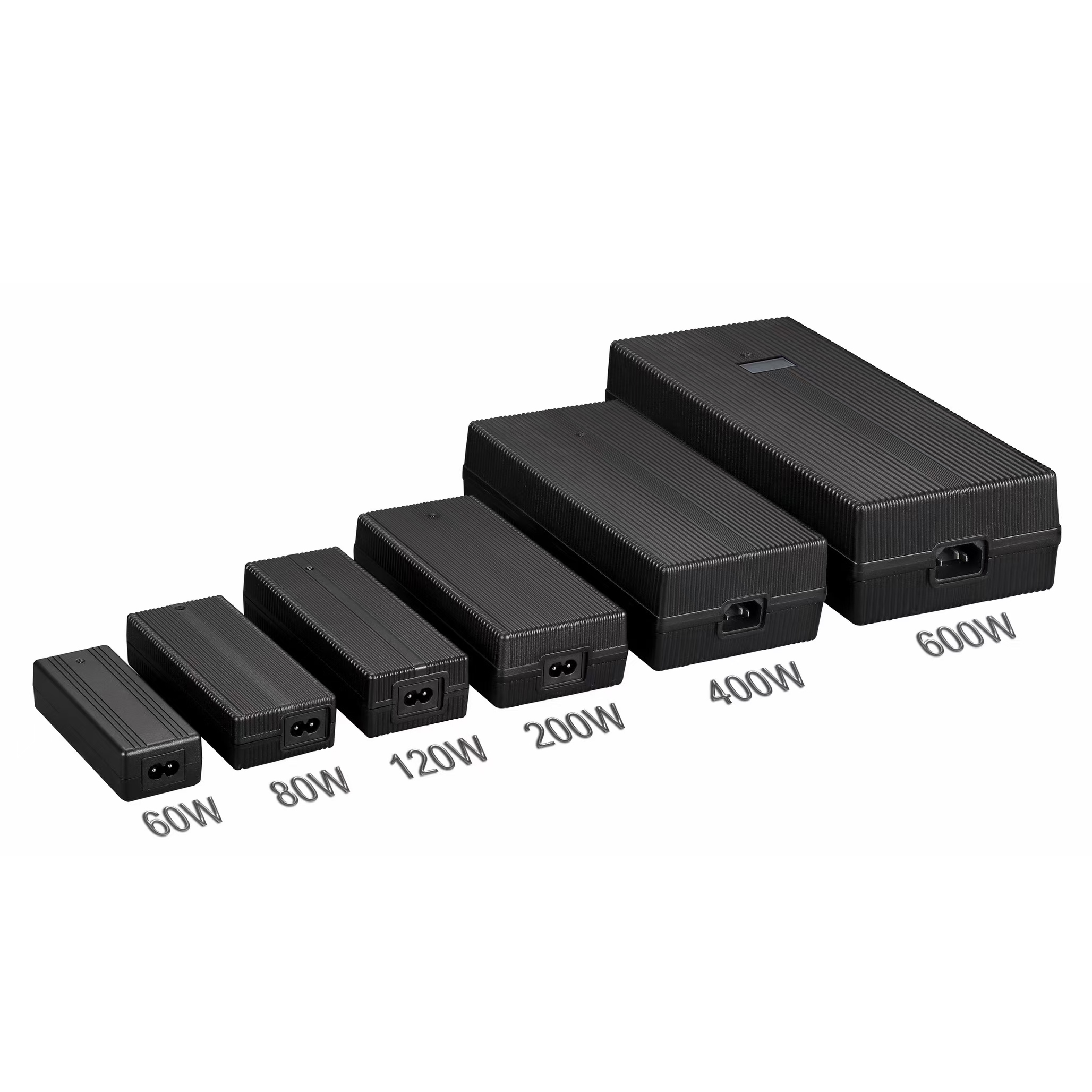
Forklift-class AMRs and heavier transfer robots run 48V packs with 10A to 15A charge currents, which lands in the 250W–400W band. At this power level, sustained output is what matters: a 400W unit at roughly 20A and 95% efficiency can restore a large pack between shifts without a long dwell time, and the higher efficiency directly reduces the heat that the charging bay has to absorb.
For large automated guided platforms and heavy battery packs, current rather than voltage becomes the constraint. Multi-output architectures distribute the load across parallel stages — a 1000W four-output configuration runs each stage independently, so heat is spread and a single stage fault does not take the entire charger offline. Sealed 1200W units with 50A output stages suit heavy electric equipment and outdoor logistics areas, and the range extends to 10KW through custom development where a standard platform is not enough.
Tip: Size by charge current first. A charger that matches the pack's maximum charge rate will complete the opportunity charge inside the dwell time; a smaller unit will simply extend the robot's idle window.
Automatic voltage and polarity detection lets a robot dock without a controlled handshake sequence, and current locking keeps the charge rate stable as pack voltage rises. At the end of the cycle, automatic voltage step-down and shut-off prevent overcharge damage during long idle periods. Protection covers short circuit, over-current, over-voltage, over-temperature and reverse polarity, with fuses on both the input and the output side.
CAN 2.0 and RS485 interfaces let the fleet management layer read charge state, voltage, current and fault codes directly. Across fifty robots, that turns charger status from a maintenance walk-around into a dashboard value.
Charging bays are dusty and some are wash-down areas, so IP67 sealing allows a unit to be mounted low on a wall or on the floor of the bay without water and dust becoming failure causes.
Tip: Specify the protocol before the hardware. If the fleet controller needs charge-state data over CAN or RS485, that requirement has to be in the original specification rather than retrofitted after installation.
An automated facility is usually subject to an internal electrical safety review, and the charger has to clear it. The relevant documents are the certificate set for the destination market — UL, cUL, ETL and FCC for North America, CE with TUV-GS and CB for Europe, UKCA for the UK, PSE for Japan, KC and KCC for Korea, SAA and RCM for Australia and New Zealand, CCC for China, BIS for India and NOM for Mexico — together with a quality system certificate.
On the manufacturing side, verifiable indicators include ISO9001, ISO14001 and QC080000 system certification, a CNAS-standard in-house EMC laboratory, 100% factory inspection with a four to eight hour full-load burn-in, and a 3-year warranty. All of those can be checked before a first order rather than discovered during a fault investigation. Fuyuan Electronic, for example, manufactures battery chargers and power adapters across a 60W–10KW range from two production bases in Dongguan and Yongzhou covering 108,000 m² with 450 employees, and supplies robot and automation programmes operated by companies including UNITREE, PUDU and iRobot.
Tip: Match the certification scope to the exact model number you are buying. A certificate that covers a different variant is not evidence of compliance for the unit in your facility.
Warehouse robot charging comes down to three specifications that a datasheet rarely highlights: sustained output at real ambient temperature, electrical cleanliness next to sensitive electronics, and predictable behaviour at end of charge. Everything else — enclosure shape, connector type, communication protocol — follows from how and where the robot operates. For reliable products and expert support, Fuyuan Electronic offers high-quality industrial battery chargers built for continuous duty, supported by a CNAS-standard EMC lab, 3,000+ developed models and OEM/ODM development that moves from design to engineering in as little as 10 days.
A: It follows the pack. Small AMRs with 5–15Ah packs work well on 120W units; 48V platforms charging at 10–15A sit in the 250W–400W band; heavy packs above 100Ah need 48V/50A or multi-output designs in the 1000W–1200W class.
A: Opportunity charging keeps a charger near full load for most of the day, so internal temperature drives component ageing. Free-air convection cooling avoids fan wear and dust ingestion, and a published derating curve shows what output remains available at the temperature of your installation.
A: Units with CAN 2.0 or RS485 interfaces can expose charge state, output voltage and current, and fault codes to the host controller, which removes the need for manual inspection rounds. This should be specified at the design stage.
A: Request the certificate numbers for your destination market, the quality system certificates, the burn-in procedure and the MTBF basis. A manufacturer with an in-house EMC lab can usually supply pre-compliance test data with the sample.
A: Minimum order quantity is 100 units for standard and customized production, and a customized design can move from concept to engineering in as little as 10 days. Warranty is 3 years. Delivery schedules and payment terms are confirmed per order.


