Views: 0 Author: Site Editor Publish Time: 2026-07-29 Origin: Site


Charging problems are one of the most frequent causes of unplanned robot downtime, and they rarely have a single cause. A delivery robot that stops mid-shift, an AGV that refuses to accept a charge or a pool cleaner that corrodes within a season usually traces back to one of four issues: an incompatible BMS protocol, an environment the charger was never designed for, excessive heat during high-power charging, or too many machines drawing power at once. Dongguan Fuyuan Electronic builds a full-power robot battery charger platform that addresses all four.
Sorting robots, delivery robots, patrol machines and pool cleaners each carry a battery management system developed by a different supplier, and the message standards rarely match. A general-purpose charger cannot read cell voltage spread or temperature data from the pack, which leads to incomplete charging and constant fault alarms.
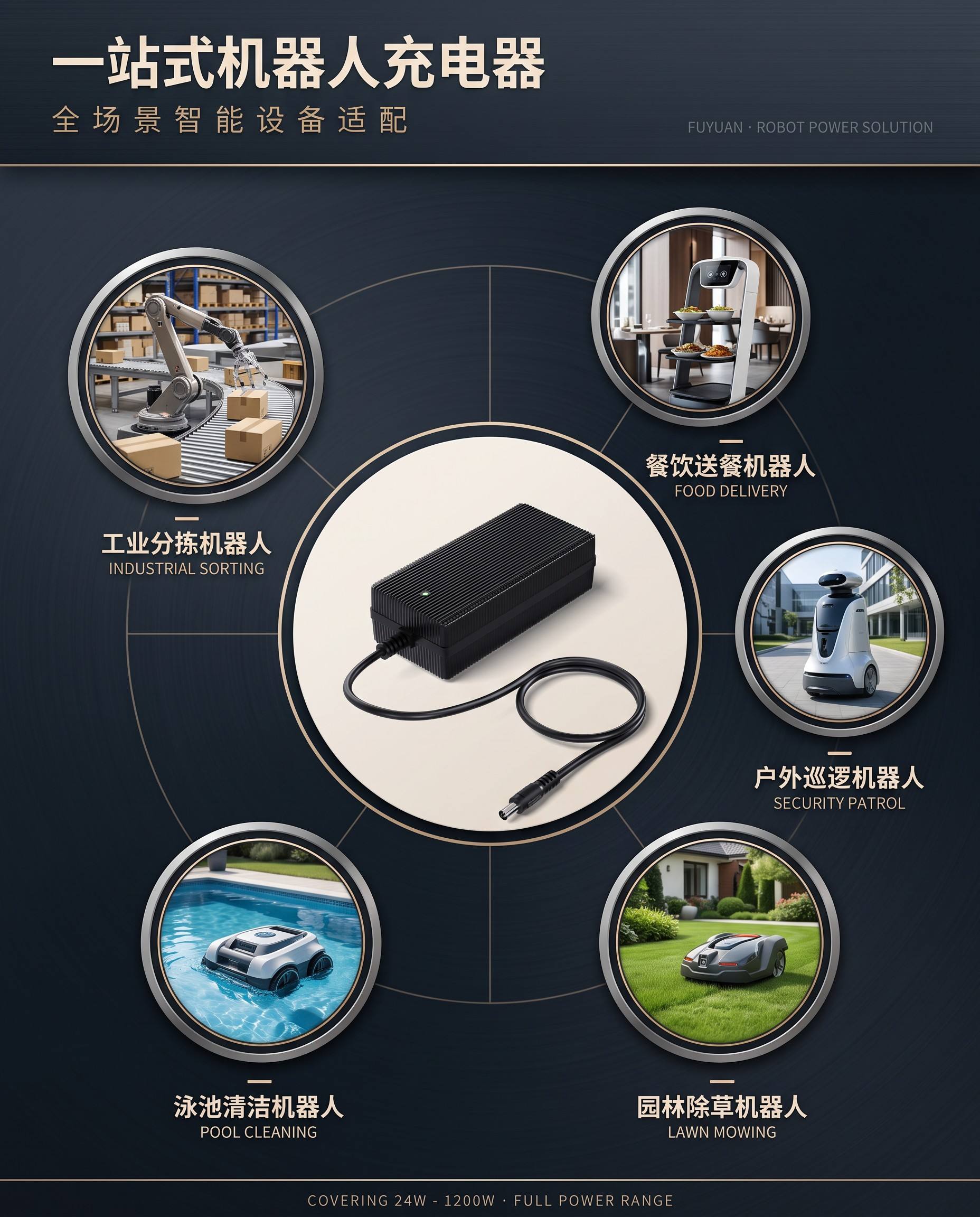
Fuyuan's engineering team reverse-engineers the customer's original BMS message set and tunes the charger to it, covering lithium ternary, LiFePO4, lead-acid and NiMH chemistries over CAN and RS485 industrial buses. A single charger model can therefore serve several robot variants with a programme adjustment, so a facility or property operator does not need to buy power supplies in separate batches for each machine type. Scenario-specific versions — delivery robot chargers, patrol robot chargers, pool-cleaning robot chargers and mower robot chargers — refine the charge curve for the duty cycle each machine actually runs.
Tip: Send the charger vendor a BMS communication log from your robot, not just the pack datasheet. The log shows which messages the charger has to answer, and it shortens the adaptation cycle significantly.
Food-service robots work around oil vapour and steam. Warehouse robots work in dust. Outdoor patrol and garden robots work through rain, snow and summer heat. Pool-cleaning robots sit next to chlorinated water. A power supply rated only for a dry indoor bench will corrode and short out in any of those conditions.
Fuyuan grades protection to the site rather than applying one specification everywhere:
Food-service and pool equipment: IP65 and IP67 sealed and potted construction with thicker gold-plated contacts for corrosion resistance.
Industrial and garden machinery: double-layer dust grilles with a conformal coating applied to the internal circuit boards.
Outdoor patrol equipment: UV-resistant housings rated for continuous operation from −29°C to +45.5°C.
The same reasoning applies to communication and control. Automatic voltage and polarity detection prevents a misconnected pack from damaging a charger or a battery, and thermal sensing plus automatic step-down or cut-off on full charge protects the pack during long unattended charging windows.
Tip: Write ingress protection into the specification by location, not by product family. Two machines from the same customer may need IP67 and IP20 chargers respectively, and that difference should be visible on the drawing.
Handling robots, warehouse sorting machines and large mower robots carry high-capacity packs that demand high charging currents. A power supply without headroom runs into its thermal limit, trips protection and stops the charge — often at the worst possible moment in a shift.
Fuyuan addresses that with GaN-based high-efficiency topologies and a 60W to 10KW catalogue, so the charger can be matched to the charging current the pack actually needs. Smart PWM-controlled fan speed follows real temperature rise, balancing cooling against noise, which allows long full-load runs without a mid-cycle pause for cooldown. Multi-port units — one unit feeding two or four batteries — let a single device recharge several packs and reduce the floor space a charging station occupies.
Peak load is the second half of the problem. When dozens of robots return to a canteen, a warehouse or a campus charging area at the same time, the combined current can overload the circuit. Industrial-grade robot chargers support host-system scheduling and can connect to MES, store management or campus operations platforms to assign charging priority and stagger start times, flattening the load profile and keeping the site running without interruption.
Tip: Model your charging schedule before you buy hardware. Staggered starts and priority assignment often remove the need for a distribution upgrade, which is the most expensive part of a fleet charging project.
Robot charging failures are engineering problems with known answers: match the protocol, grade the protection to the site, size the power stage for real charging current, and schedule the fleet instead of letting it charge all at once. Fuyuan covers those four requirements from one supplier, with a 60W–10KW range, IP67 options and CAN 2.0 or RS485 communication. For reliable products and expert support, Fuyuan Electronic offers high-quality robot battery chargers engineered for continuous duty, backed by two production bases and a CNAS-standard in-house EMC laboratory.
A: In many cases, yes. Fuyuan tunes the charger to the customer's BMS message set and supports lithium ternary, LiFePO4, lead-acid and NiMH packs over CAN and RS485, so several machine models can share one charger platform with different charge programmes.
A: IP65 and IP67 sealed and potted designs are available for food-service, pool and outdoor equipment, with gold-plated contacts, conformal-coated boards and UV-resistant housings for different site conditions.
A: GaN-based high-efficiency topologies reduce losses, and smart PWM fan control adjusts speed according to measured temperature rise, which allows extended full-load charging without an intermediate cooldown stop.
A: Industrial-grade chargers support host-system scheduling and can integrate with MES, store management or campus operations platforms to assign charging priority and stagger start times, spreading the load across the shift.
A: From 60W to 10KW, including multi-output models such as a 160W dual-channel unit, a 1000W four-channel unit and a 3000W IP67 model, with more than 3,000 models developed across the catalogue.


