Views: 0 Author: Site Editor Publish Time: 2026-04-08 Origin: Site


Adding a second delivery robot does not double throughput if both units queue at the same wall socket. A restaurant service robot charging management system is the part of the deployment that decides when each robot charges, where it docks and what the operator can see — and the restaurant robot charger is the hardware that makes the schedule physically possible.
Consider what the charging layer has to do in a working restaurant. It converts mains AC into the DC profile each pack expects, confirms the pack is in a safe state before current flows, returns status to whatever system supervises the floor, and stays invisible to guests. When it works, nobody notices it. When it does not, the symptom is a robot standing still during peak service.
Conversion efficiency sets the baseline for everything downstream. Fuyuan chargers run from 60 W to 10 kW across more than 3,000 developed models, with GaN/SiC platforms at 120 W, 240 W and 330 W reaching up to 95% efficiency. Higher efficiency means less heat in a space that already runs warm, and less electricity consumed per delivered kilowatt-hour — a difference that becomes visible across a chain.
Chargers with CAN 2.0 or RS485 interfaces publish voltage, current, temperature and fault state. That is what turns a set of sockets into a managed system: the floor supervisor can see which robots are ready, maintenance can compare charge curves across units, and a pack that takes progressively longer to fill becomes visible before it fails.
Overnight charging happens with no one on the premises, so the automatic functions carry the risk: cutoff at full charge, no-load shutoff, timed termination, and protection against short circuit, overcurrent, overvoltage, over-temperature and reverse polarity, with fuses on both the input and the output side.
Tip: Treat the charging schedule as an operations document, not a technical footnote. Assign one person to own the peak-hour charging plan, and review it when robot count changes.
Restaurant layouts differ more than their menus suggest, and the charging method has to follow the building rather than an abstract preference for one technology.
Contact charging suits most dining rooms: high efficiency, predictable performance, and a housing that can be tucked into a corner or beside a service entrance. The design attention goes on the contact interface, which has to survive hundreds of dockings per month without building resistance. Constant-current/constant-voltage charging with multiple protection layers protects both the pack and the contact assembly.
Inductive charging removes exposed contacts and tolerates loose docking alignment, which helps in venues where the dock sits in a visible area or under furniture. Plan for a longer charge window and a controlled coil gap; the trade is maintenance exposure against charging speed. Fuyuan offers customisable converter configurations for this arrangement.
Large canteens and staff dining centres with concentrated meal windows benefit from pack swapping, because the robot returns to service in minutes. The charger then serves a rack of packs rather than one robot, which favours higher-power units and multi-output configurations such as the 160 W dual-output and 1000 W four-output models.
Tip: Map cable routes and docking space on the floor plan before ordering. Most installation problems are spatial, not electrical.
Two decisions carry most of the operational value: where the docks go and in what order robots use them.
Put charge points out of the guest path but close to where robots idle, and leave ventilation clearance around the units. In zones exposed to steam, spills or wash-down, IP67 units — available from 60 W to 3000 W in plastic or aluminium housings — remove water ingress from the failure list. Low-noise fanless designs also keep the back-of-house quieter during service.
Grouping all docks onto one feed creates a synchronised demand spike when the fleet returns together. Spreading charge starts, limiting per-unit current, or scheduling the deep charges into off-peak hours all flatten that draw without extra robots. Multi-output chargers simplify the same problem by concentrating several packs on one managed unit.
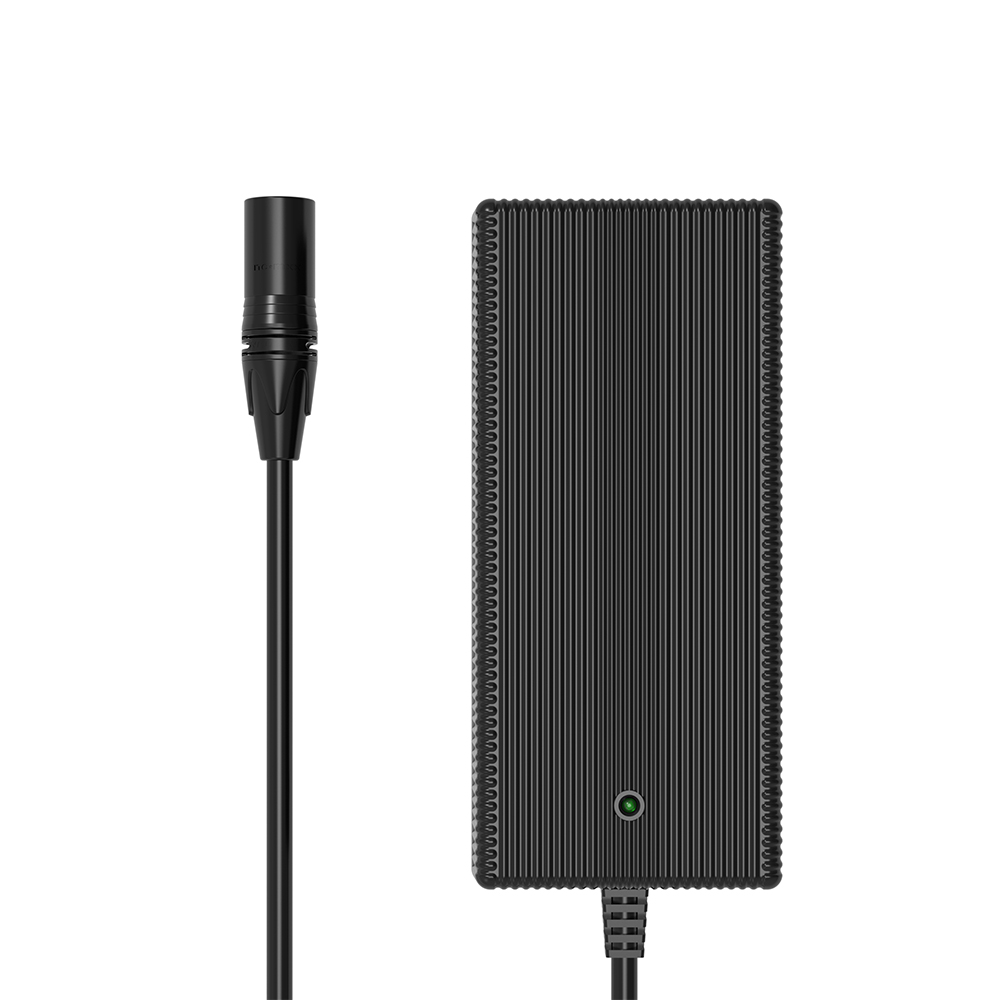
The way a fleet is charged determines how often packs are replaced. Avoiding partial-charge churn, terminating properly at full charge and keeping current within the pack supplier's limits all extend service life. Data from the charger is what makes those patterns visible, and RoHS- and REACH-compliant materials keep the installation within purchasing policies for food-contact environments.
Tip: Review charge data monthly. A rising charge time on one unit is a low-cost early warning of a failing pack.
A charging system that cannot be serviced quickly is a single point of failure for the whole floor, so the supplier side matters as much as the electronics. Fuyuan holds ISO 9001, ISO 14001, QC 080000 and BSCI, runs a CNAS-standard in-house EMC laboratory, and performs 100% factory inspection with a 4–8 hour full-load burn-in on each unit. MTBF is rated at 30,000 hours or more, backed by a 3-year warranty.
Certification covers UL, cUL, ETL, FCC, TUV-GS, CE (EMC and LVD), CB, KC, KCC, PSE, SAA, RCM, UKCA, CCC, NOM, BIS, RoHS and REACH, with certificate numbers available for verification. Custom work covers output parameters, interface, enclosure finish and labelling, beginning at a 100-unit MOQ with design-to-engineering turnaround as fast as 10 days. Sample policy, payment terms and production lead times are set by the sales team for each project.
A restaurant charging system is a scheduling problem with a power-electronics answer. Start with the service peaks, then choose docks, charging methods and reporting that keep robots available when guests are ordering. For reliable products and expert support, Fuyuan Electronic offers high-quality chargers for restaurant service robots and fleet charging stations.
A: Enough to charge every robot inside the longest service gap, plus one spare position for maintenance. Work from the peak-hour chart rather than the total robot count, and check the panel capacity before adding positions.
A: Yes. Chargers with CAN 2.0 or RS485 interfaces report voltage, current, temperature and fault status, which can be surfaced on a supervisor dashboard or logged for maintenance analysis.
A: Units support automatic cutoff at full charge, a no-load shutoff and timed termination, so an unattended robot cannot keep receiving current after the pack is full. Protection functions cover short circuit, overcurrent, overvoltage, over-temperature and reverse polarity.
A: The IP67 range covers 60 W to 3000 W in plastic or aluminium housings. The 3000 W unit delivers 35–87 V at up to 35 A for larger packs.
A: MOQ is 100 units, with OEM/ODM support for custom functions, connectors, labelling and logos. Design-to-engineering work can be completed in as little as 10 days; sample, payment and lead-time details are confirmed per project by the sales team.


