Views: 0 Author: Site Editor Publish Time: 2026-01-27 Origin: Site


A power adapter is a small line in most bills of materials and the component most often chosen last. That ordering is why adapters fail in the field before anything else does: a unit picked on connector size and price rarely matches the load's real current draw, the enclosure's thermal reality, or the compliance requirements of its destination market. Getting the selection right takes seven specification checks and one honest measurement of what the equipment actually consumes.
A power adapter converts mains AC into a regulated DC output that suits a specific load, and it isolates that load from the grid while doing so. Isolation is the requirement people forget. Switching topologies, transformer construction and creepage distances are what separate a supply that can be used safely in a metal enclosure from one that puts mains potential within reach of a service technician.
Beyond conversion, an adapter has to hold its output steady while the input moves. Mains voltage wanders, other equipment injects noise onto the same circuit, and load current changes as a device switches between idle and peak operation. Regulation, ripple and transient response decide whether the load sees a clean rail or a wobbling one.
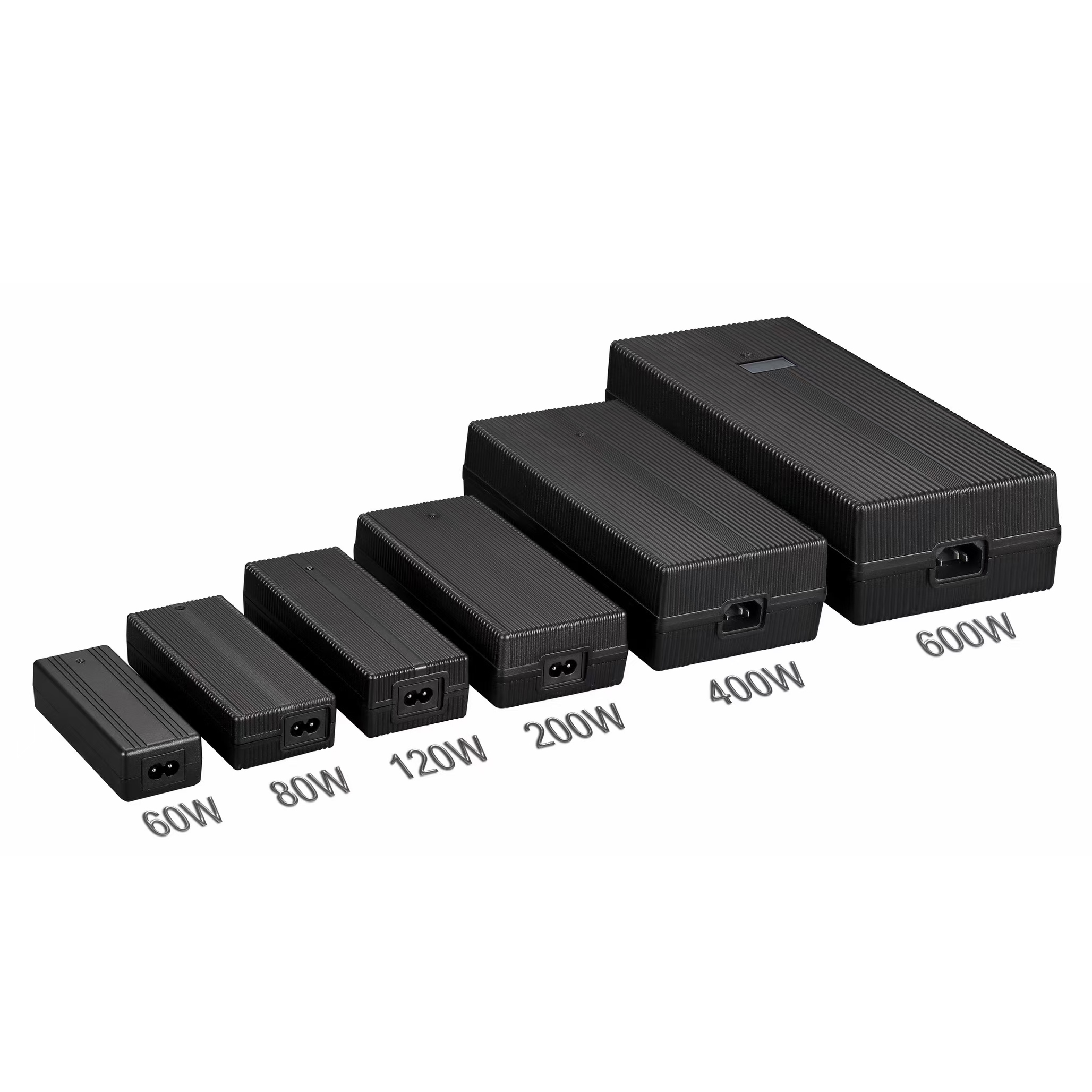
Power is voltage multiplied by current, and the figure that matters is continuous output, not peak. Choose a rating 10–20% above the measured demand: undersized units run hot and throttle when they are needed, while heavily oversized ones add cost, weight and no-load losses for no gain. A 60W unit suits routers, cameras and small audio gear, 150–250W covers workstations and laptops, and 600W and above takes over for motive power and robot packs.
Output voltage must match the load's rated input; a deviation of more than a few percent disturbs sensitive circuitry. Adjustable output helps when one product family covers several voltages — an 8V–87V window lets one platform serve multiple devices, provided the current rating is verified at the highest voltage you use. Current capability is the second half of the check: a load drawing 5A will trip an overload-protected 3A unit into repeated shutdown.
Efficiency determines how much input power becomes heat. A unit delivering 200W at 90% efficiency draws about 222W; at 85% it draws roughly 235W, and that extra 13W leaves the enclosure as heat. Figures of 90–95% are normal on well-designed supplies above 120W. Look for a recognised energy standard — DoE Level VI, ErP Stage 2, CoC Tier 2 or CEC — since those programmes also cap standby consumption, which is where an always-on adapter spends most of its life.
Short circuit, overload, overvoltage, over-temperature and reverse polarity should each have their own detection path. A design that handles all five in firmware leaves the equipment unprotected if the controller fails, which is why physical fusing on both sides matters — a blown fuse is cheaper than a shorted switching stage.
Ripple is the AC content riding on the DC output, measured in millivolts peak-to-peak. Audio equipment turns it into hum, instrumentation into measurement error, and a BMS into voltage readings it cannot trust. General-purpose supplies should stay at or below about 150mV, and precision or medical loads want 50mV or less. Only a figure quoted at full load is worth taking seriously.
Mean time between failures lets you compare designs on something other than price. Industrial-grade adapters commonly specify 30,000 hours or more, roughly three and a half years of continuous operation, while consumer units frequently carry no figure at all. Burn-in practice is the companion metric: several hours at full load and elevated ambient temperature screens out units that would otherwise fail in their first month.
Compliance is market-specific. CCC applies in China, CE with EMC and LVD coverage in the EU, UL or ETL in the United States, PSE in Japan, KC in Korea, UKCA in the United Kingdom, and SAA or RCM in Australia and New Zealand. CB certificates convert into national approvals with less repeated testing. Products intended for medical equipment need to meet IEC 60601 expectations, and outdoor or wash-down installations call for IP-rated enclosures, not sealing applied after the fact.
Tip: Measure the load's real current with a power meter under peak conditions before ordering. Datasheet figures are usually quoted at nominal load, rarely the worst case.
Home and office equipment: routers, cameras and smart speakers want 60–90W, 8V–24V output and a wall-plug format, with efficiency of 88% or better.
Mobile computing: laptops and portable monitors sit in the 90–120W band at 19–20V, where weight and multi-region certification matter more than maximum power.
Outdoor and harsh environments: site lighting, outdoor surveillance and wash-down areas need IP67 sealing, aluminium housings and fixed cable entries.
Light electric vehicles: scooters, balance boards and battery packs want 150–600W with charge management. Where the source is a vehicle bus, a DC-DC converter with 12–30V input avoids converting DC to AC and back.
Industrial automation: AGVs, robot arms and control cabinets need 300W and up, efficiency of 95% or higher, and multi-channel outputs so one failed channel does not stop a line.
Medical and laboratory: monitors, infusion pumps and analysers need medical-grade isolation, low leakage current, ripple at or below 50mV and the relevant safety approvals.
An uncertified adapter may use capacitors and wiring never validated at the operating temperature on the label. Certificate numbers can be checked against the issuing body's register.
Surplus capacity does not improve reliability. It increases no-load draw, adds bulk and shifts the operating point away from the design's efficiency peak. Size to the measured load with a modest margin.
Every watt of loss leaves the enclosure as heat, and internal temperature drives electrolytic capacitor ageing. Plastic housings suit ventilated indoor installations; metal housings suit high ambient temperatures and restricted airflow.
Wide-range output is useful on a service bench, but it does not replace matching. Confirm the current available at the voltage you need, and that the DC plug fits without an adapter that adds contact resistance.
For a part that runs continuously, warranty length and a documented returns process are operating costs you avoid. A supplier holding ISO 9001 certification, publishing MTBF data and offering three-year coverage makes claims you can verify.
Fuyuan Electronic has developed adapters, chargers and LED drivers since 2005 across a 60W–10KW range, with more than 3,000 models, GaN and SiC designs at 120W, 240W and 330W reaching up to 95% efficiency, ISO 9001, ISO 14001 and QC080000 systems, and a CNAS-standard EMC laboratory.
Tip: Match the DC connector as carefully as the electrical rating. A loose plug introduces voltage drop and intermittent contact that no protection circuitry will fix.
Adapter selection is a matching exercise: measured load current against continuous rating, output window against device input, ripple against sensitivity, sealing against environment, certification against destination. Units that fail early are usually where one of those five matches was assumed rather than checked. For reliable products and expert support, Fuyuan Electronic offers high-quality power adapters engineered for continuous duty.
A: Around 10–20% above the measured continuous load, which covers conversion losses, high ambient temperature and inrush events without pushing the unit into overload protection.
A: Not for charging. A battery needs a higher voltage than its nominal rating to reach full charge — 54.6V for a 13S lithium pack or 58.4V for a 16S LiFePO4 pack. A 48V adapter is suitable for powering equipment, not for completing a charge cycle.
A: Around 150mV peak-to-peak or less for general-purpose loads, and 50mV or less for audio, laboratory and medical equipment. Always ask for the figure at full load.
A: Medical equipment has stricter isolation and leakage-current requirements, typically addressed through IEC 60601 expectations, plus tighter ripple limits. A general-purpose ITE supply does not automatically satisfy them.


