Views: 0 Author: Site Editor Publish Time: 2026-01-27 Origin: Site


A 48V lithium pack and a 12.6V three-cell pack cannot share a charger, and the label on the battery is the only reliable starting point. This guide walks through the parameters that decide whether a lithium battery charger lasts through five years of daily cycling or fails in its first hot summer: output voltage window, current taper, chemistry-specific charge curves, thermal path, and the certification set your destination market actually enforces.
Most specification errors trace back to starting with a wattage copied from an old nameplate. The pack defines the charger, not the other way round: cell chemistry sets the top-of-charge voltage per cell, the series count multiplies it, and capacity in amp-hours decides how much current the pack will accept before ageing accelerates.
A single Li-ion cell reads 3.7V nominal and is charged to 4.2V. Ten cells in series therefore show 37V on the pack label but need 42V at the charger terminals. The arithmetic scales across the market: 3S packs charge at 12.6V, 13S e-bike packs at 54.6V, and large industrial strings run from 58V up to 87V. A charger whose output window never reaches the pack's full-charge voltage leaves it permanently part-charged and cycling in the middle of its range. One that overshoots by even two percent costs cycle life.
Charge current is normally written as a multiple of capacity, so a 10Ah pack charged at 10A sits at 1C, and a 20Ah pack at 20A is also at 1C. Routine charging above 1C pushes lithium plating and heat generation; 0.5C to 1C is the normal daily band, with 1.5C reserved for urgent top-ups.
LiFePO4 tops out near 3.65V per cell, NMC and NCA near 4.2V, and LTO lower still. A charger configured for 4.2V per cell will overcharge a LiFePO4 pack, and the word "lithium" on a datasheet is not enough to confirm compatibility. Confirm chemistry before requesting pricing, especially on lead-acid replacement projects where the same vehicle is being migrated from SLA to LiFePO4 packs with a lower full-charge voltage than the original system.
Tip: Ask for the pack datasheet first. Chemistry, series count, capacity and maximum charge current give a supplier everything needed to propose an output voltage and current, and they remove one wrong-sample round from the project.
A CC-CV profile — constant current until the pack reaches its top voltage, then constant voltage with a tapering current — remains the default for lithium chemistries. What separates finished products is what happens after the taper: the current cut-off threshold, a timer that ends the session if the pack never reaches full, and standby behaviour that does not keep trickling into a charged pack. Automatic shutdown at full charge matters more in practice than an extra half-amp of charge current.
Conversion efficiency shows up twice, once in the electricity bill and once in internal temperature rise — and it is temperature that limits service life. Professional units generally run above 90% at full load, and GaN/SiC platforms reach 92–95% at the 120W, 240W and 330W levels. The regulatory side has its own vocabulary — DoE Level VI and CEC for North America, ErP Stage 2 and CoC Tier 2 for the EU — and claiming compliance is not the same as holding a test report. Ask for certificate numbers.
Over-voltage, over-current, over-temperature and short-circuit protection are the baseline. Two items deserve an explicit question: fuses on both the input and the output side, and reverse-polarity protection, which stops a mis-wired connector from destroying both the charger and the pack.
Free-air convection cooling with no fan is the norm for sealed industrial chargers: no bearing to wear out, no dust drawn through the chassis, no audible noise in a workspace. The trade-off is that the enclosure becomes the heatsink, which is why aluminium housings are chosen for outdoor and industrial duty and plastics for indoor, cost-sensitive products. Always read the derating curve: whether a 400W unit still delivers 400W at 45°C ambient is the question that matters.
IP67 sealing covers wash-down bays, garden equipment and exposed outdoor installations, and allows the unit to be mounted where water collects rather than being sheltered. On fleet deployments, CAN 2.0 or RS485 interfaces turn a charger into a monitored asset: charge state, fault codes and accumulated cycle data can be read by the host controller instead of being inferred from a status LED.
Tip: Request the derating curve, the protection list and the communication protocol alongside the datasheet. Those three documents reveal more about field behaviour than the headline wattage ever will.
E-scooters, balance boards and e-bikes typically carry 5Ah to 15Ah packs at 36V, 42V or 54.6V. In the 120W–250W class a cycle completes in two to four hours, which fits overnight charging and top-ups between shifts. Portability, connector fit and behaviour under a hot battery matter more than peak current.
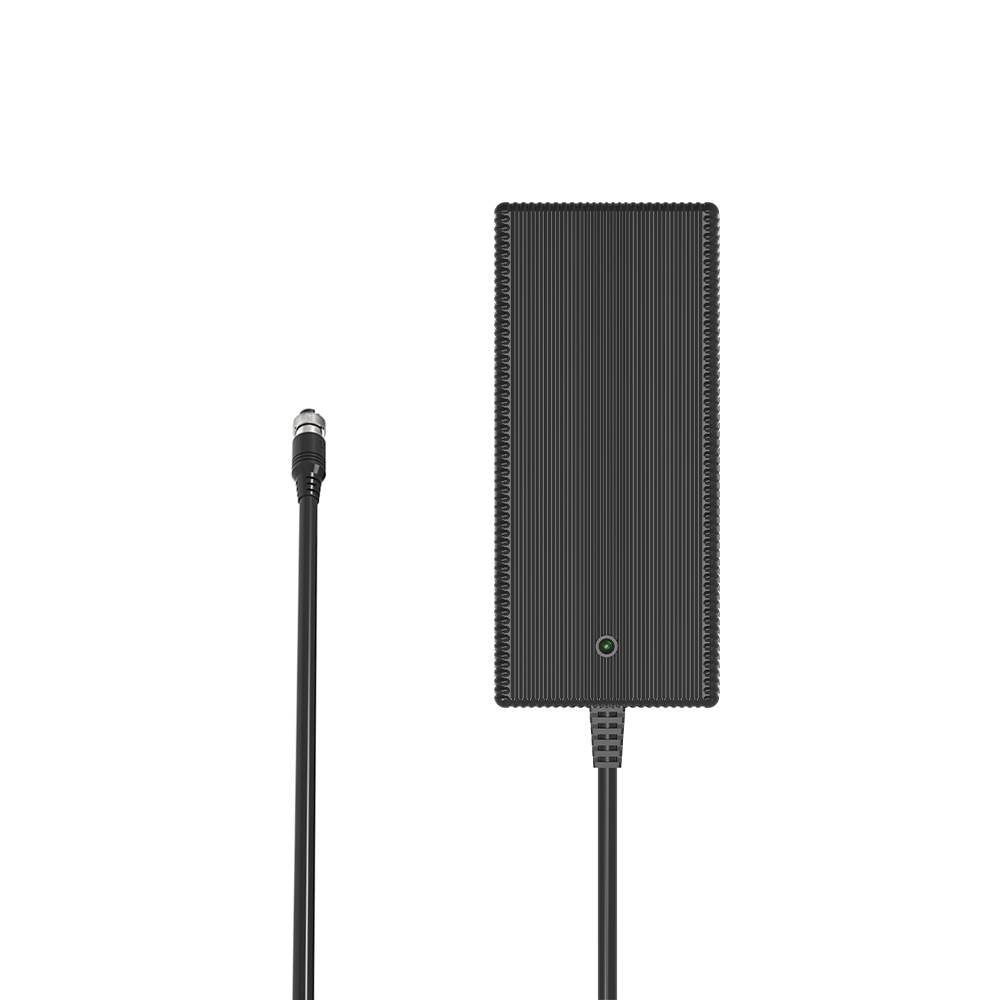
A representative unit in this class is the FY4203000, a 120W model that pairs a compact desktop case with the voltage window used by 10S packs.
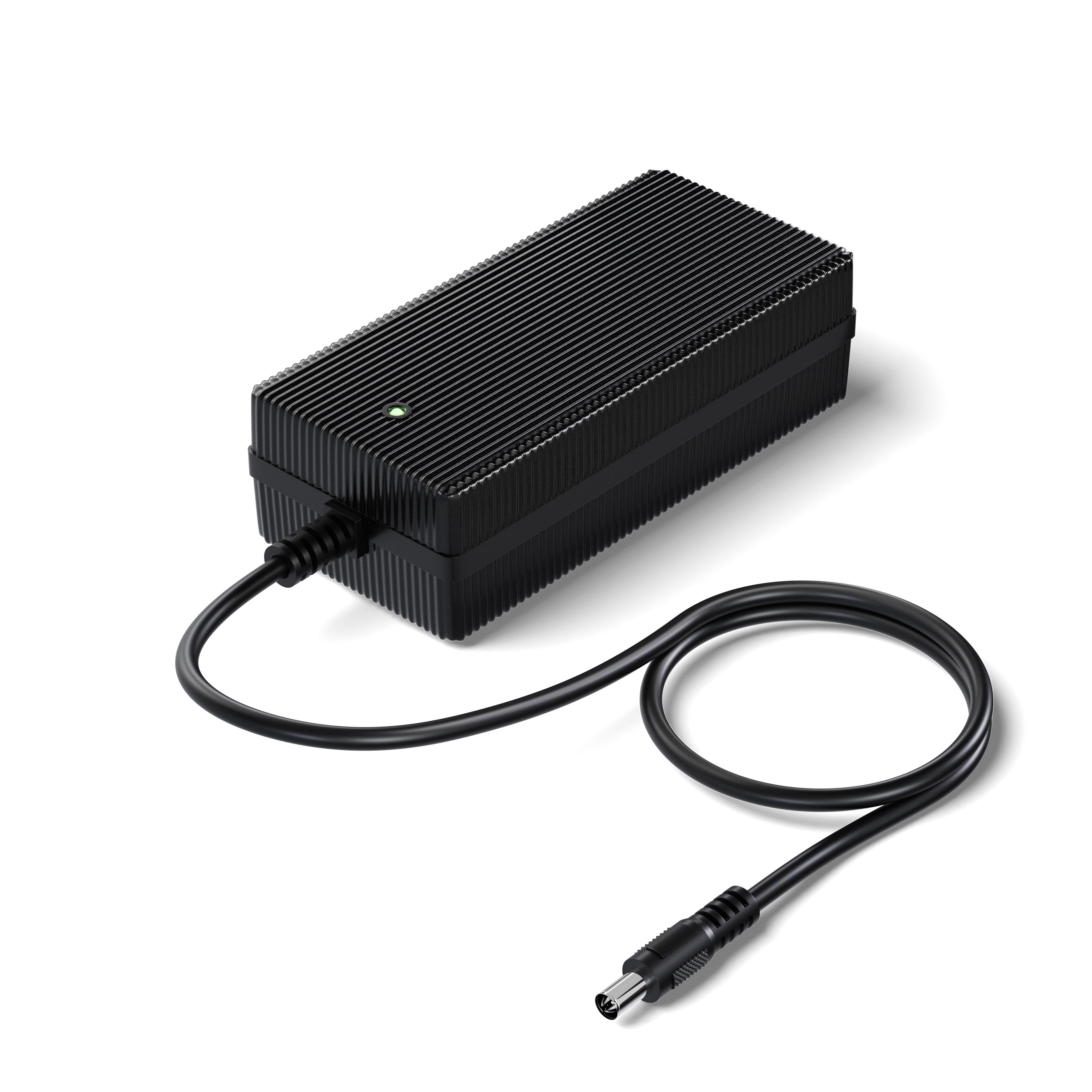
Mobile robots on multi-shift duty need chargers that tolerate continuous operation. The design priorities shift to low ripple, so sensor and control electronics are not disturbed, and to a thermal design that holds steady through long full-load periods. The 300W–600W class, typically configured for 48V at 10A to 15A, covers most AMR and AGV platforms, with efficiency above 92% and MTBF of 30,000 hours or more as reasonable selection criteria.
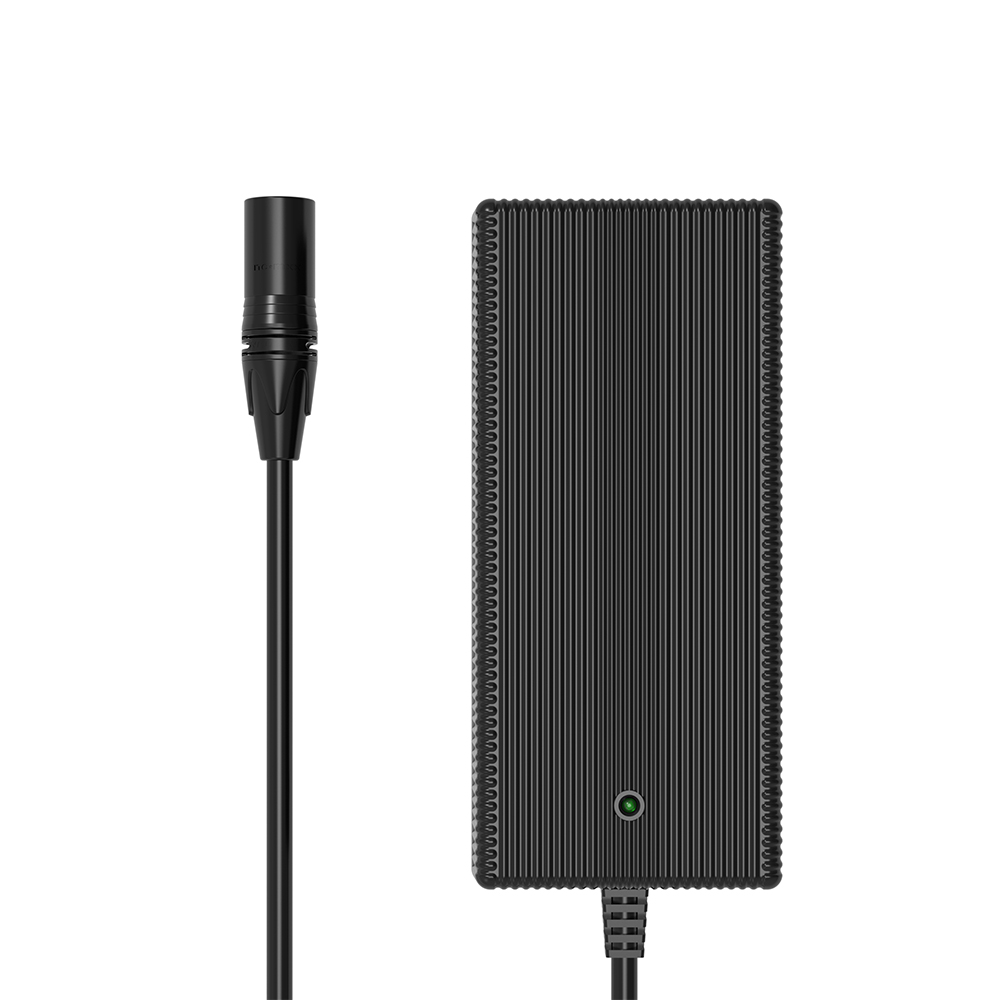
The FY5845000 sits at 300W for medium-duty platforms, while the FY42010000 delivers 400W for larger packs and heavier duty cycles in the same 48V range.
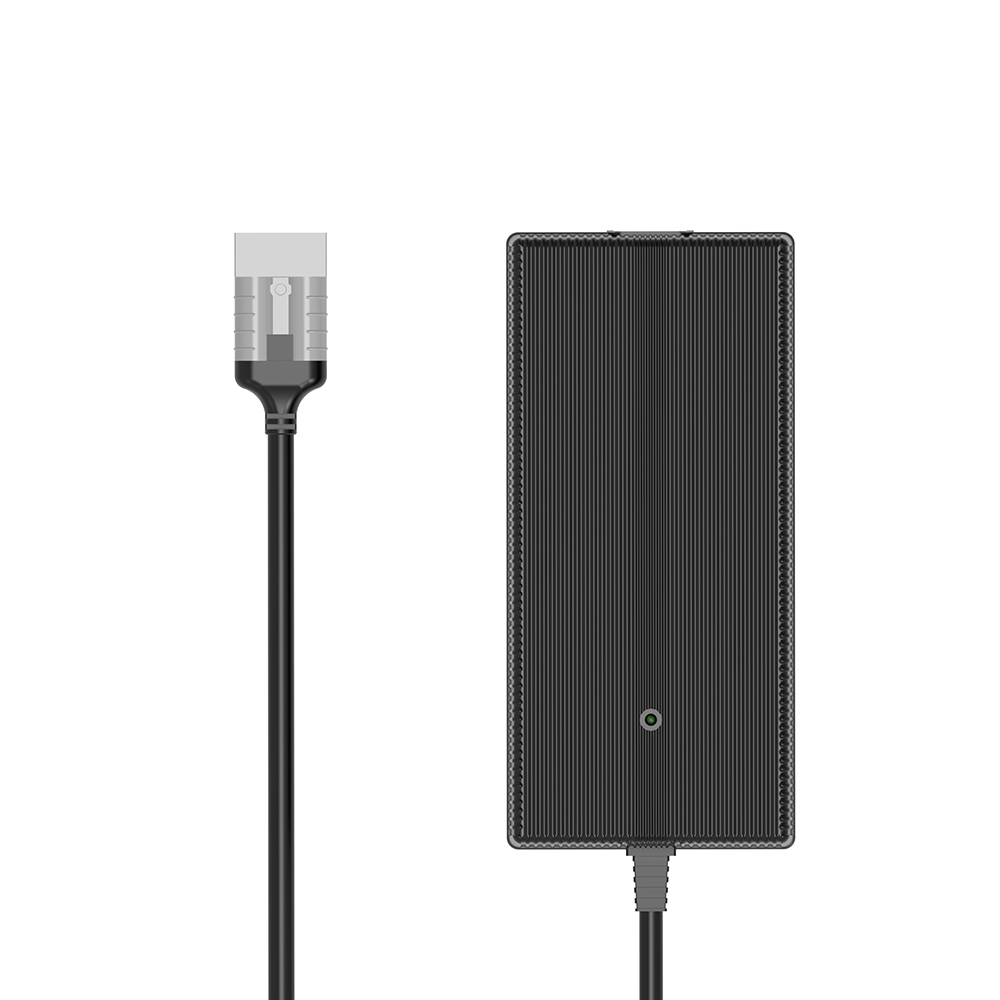
Mowers, pool robots and outdoor lighting run in rain, dust and temperature swings. A 60W–120W IP67 unit with an aluminium housing and fixed AC and DC cable entries removes the two most common failure points in that environment: water ingress and a loose connector. Sealed units also survive being hosed down during routine cleaning.
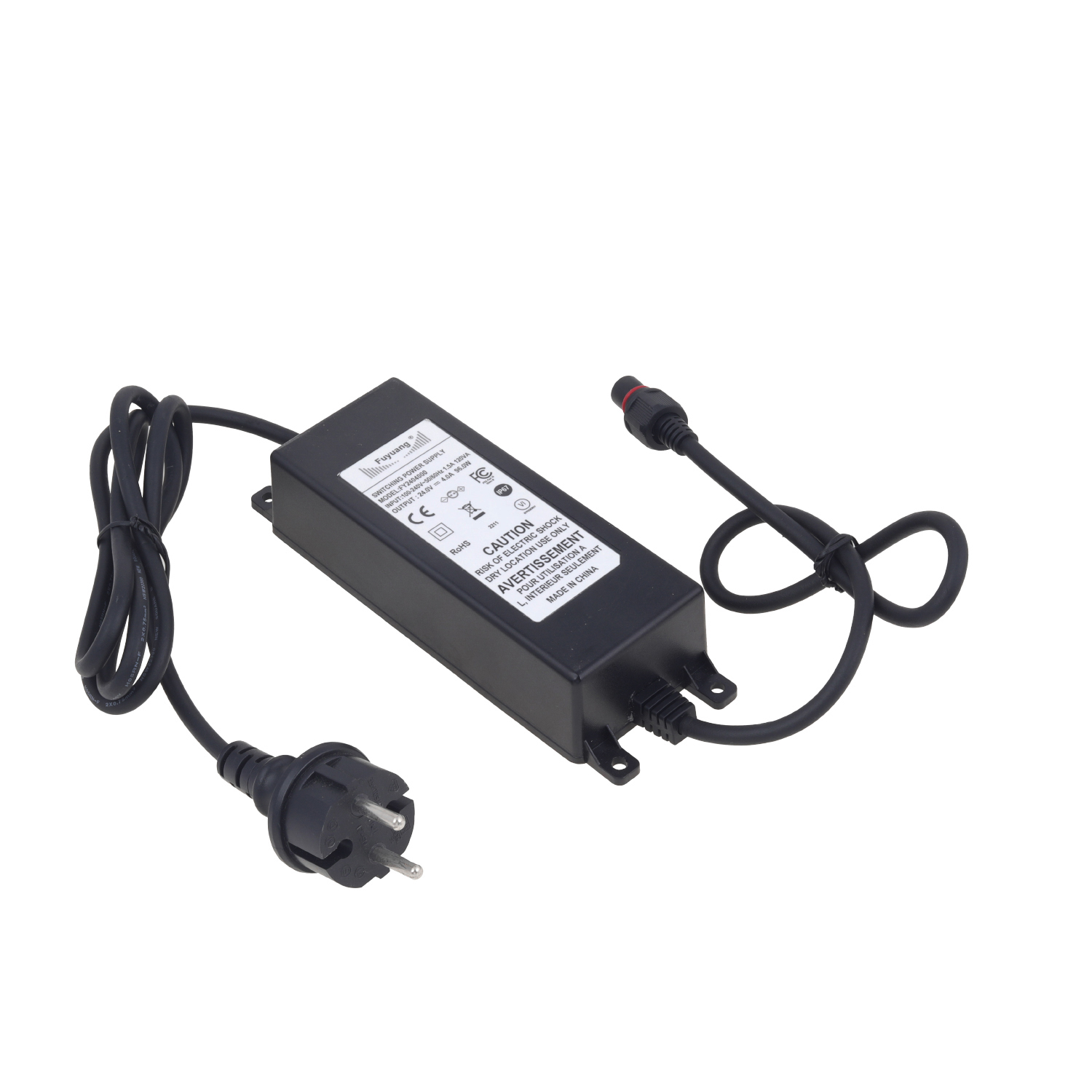
Charging equipment for medical and laboratory devices is specified on electrical safety rather than charge speed: reinforced isolation, low leakage current, tight EMI margins and a stable output. Dual-output designs let a device keep its control electronics on one rail while the battery charges on the other.
Above roughly 100Ah, charge current becomes the limiting factor. A 48V/50A or 72V/20A configuration is typical for these packs, and multi-output designs spread the heat across parallel stages instead of concentrating it in one converter. Aluminium housings and generous derating margins are standard at this power level.
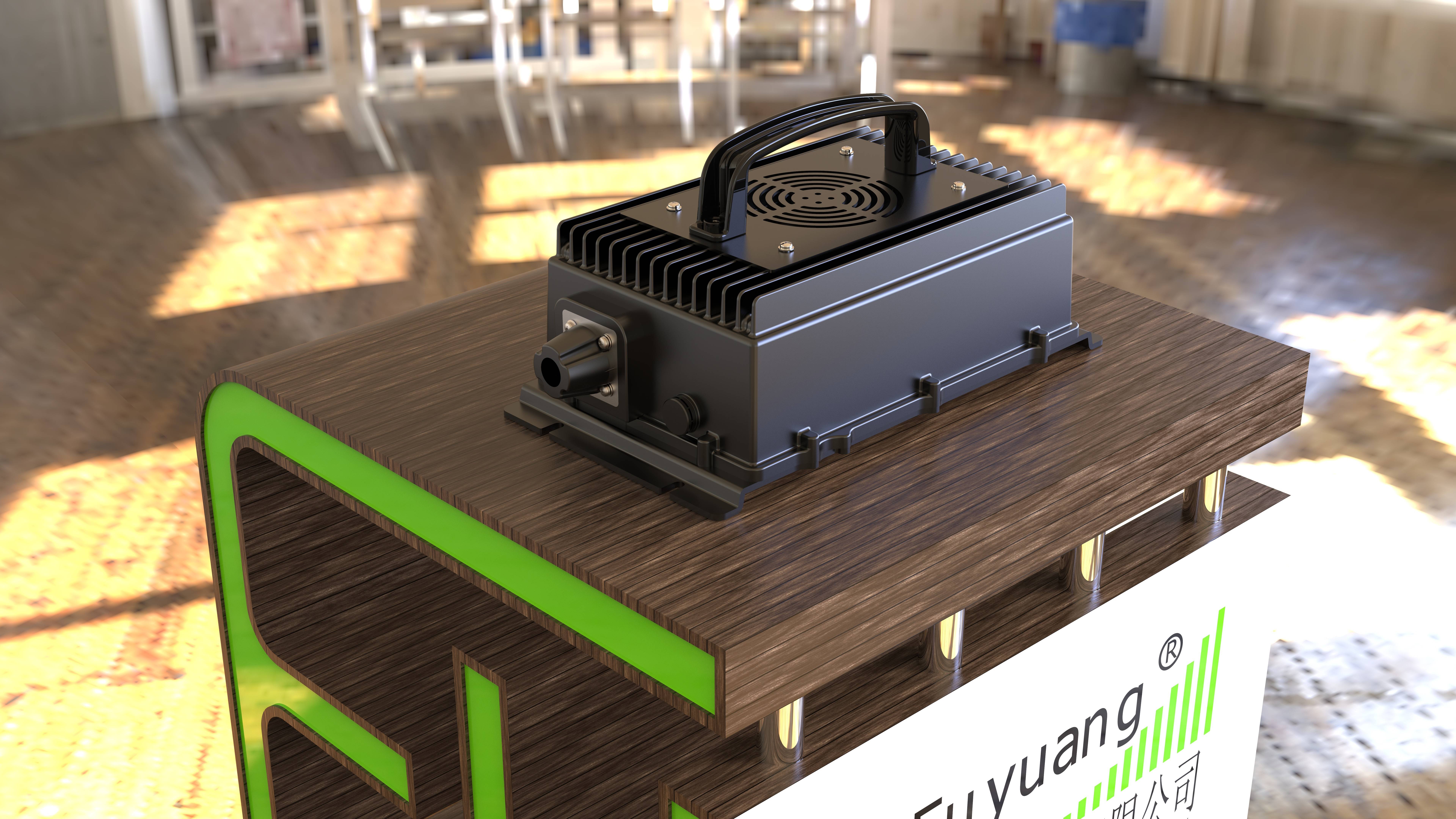
The FY48025000 illustrates the class: 1200W with a 50A output stage, aimed at heavy electric equipment and large-capacity packs. For fleets above that, the range continues to 10KW through custom development.
RVs, boats and mobile workstations rarely have mains power at the point of use. A DC-DC converter drawing from a 12–30VDC house supply avoids the double conversion loss of running an inverter first and handles the wide input swing of a vehicle electrical system.
Tip: Write down the power class, ingress rating and connector type before comparing quotations. Two chargers at the same wattage can differ by a factor of three in service life once the operating environment is taken into account.
Bigger is safer. An oversized charger pushes a small pack toward its current limit and shortens its life. Size to voltage multiplied by the intended current, then add 10–20% headroom.
Certification is paperwork. An uncertified unit may have inadequate creepage distance, missing protection and no traceable test data. Match the certificate set to the market of sale.
Connectors are interchangeable. DC barrel dimensions, XT60, XT90 and Anderson variants are not cross-compatible, and undersized wire causes voltage drop that slows charging.
One charger fits all lithium packs. LiFePO4, NMC, NCA and LTO have different charge voltages. Treating them as one category is the fastest route to a failed battery.
Fast charging every day is fine. High current raises internal resistance and heat. Daily charging in the 0.5C–1C band with fast charging held in reserve is the conventional compromise.
Collect the pack data. Chemistry, series count, nominal voltage, full-charge voltage, capacity and maximum charge current.
Size the charger. Multiply charge voltage by target current, then add headroom instead of doubling it.
Check the market's certification set. UL, cUL, ETL and FCC for North America; CE and TUV-GS with CB for Europe; UKCA for the UK; PSE for Japan; KC and KCC for Korea; SAA and RCM for Australia and New Zealand; CCC for China; BIS for India; NOM for Mexico.
Match the environment. Indoor natural convection in a plastic case is fine on a shelf; anything outdoors, mobile or washed down should be IP67 aluminium.
Confirm commercial terms in writing. Warranty length, minimum order quantity, customization path and delivery schedule belong in the quotation, not in a verbal assurance.
Choosing a lithium battery charger is a matching exercise, not a price comparison. The pack defines the voltage window and current limit, the environment defines the enclosure and ingress rating, and the market of sale defines the certification set. Get those three right and the remaining decisions are refinements rather than risks. For reliable products and expert support, Fuyuan Electronic offers high-quality lithium battery chargers from 60W to 10KW, with 3,000+ models developed, a 3-year warranty and a CNAS-standard in-house EMC lab behind the certification process.
A: A 13S Li-ion pack labelled 48V charges to 54.6V, while a LiFePO4 pack of similar nominal voltage charges to a lower per-cell limit. Confirm the chemistry and series count first, then choose a charger whose output reaches the pack's full-charge voltage and whose current stays within the pack's rated charge rate.
A: Only if it is adjustable enough to be set correctly for each chemistry, and only if the setting is locked and verified. Charging a LiFePO4 pack with a 4.2V-per-cell profile will overcharge it. Where several chemistries share a fleet, specify separate output configurations rather than relying on field adjustment.
A: Pack chemistry, voltage, capacity and maximum charge current, plus the operating environment, target market and connector type. Minimum order quantity is 100 units, and customized designs move from concept to engineering in as little as 10 days.


