Views: 0 Author: Site Editor Publish Time: 2026-04-20 Origin: Site


A welding cell that runs three shifts needs a charging window that fits between cycles, not a bigger battery. That makes the industrial robot battery charger part of the cell design: it decides how quickly a pack returns to service, how much heat the enclosure has to shed, and whether the charge profile stays stable next to a bank of welding inverters.

Sorting, palletizing, welding, assembly, machine-tending and inspection robots share one operating pattern: the cell runs continuously, and every minute a robot spends tethered to a charger is a minute of lost throughput. Chargers sized for consumer equipment assume a leisurely overnight recharge. Industrial duty cycles do not, and the mismatch shows up as derating, nuisance trips or shortened pack life.
Power versus heat. Higher current shortens the recharge window but raises losses in the transformer, rectifier and wiring. Without thermal headroom, the unit derates or shuts down exactly when the fleet needs it most.
Fleet scheduling. When twenty robots return to their docks inside the same half hour, the combined draw can disturb the panel. Staggered charging and per-unit current limits matter as much as peak wattage.
Electromagnetic environment. Welding inverters, variable-frequency drives and servo amplifiers inject noise into the supply. A charger sharing that environment needs adequate filtering and a control loop that does not drift.
Start from the shift pattern rather than the battery nameplate. A robot that gets a short opportunity charge every second mission needs a high-current profile with tight voltage regulation; one that swaps packs once per shift is better served by a moderate current and a longer tail. Map the rest intervals first, then size the charger so it finishes inside the smallest one.
Tip: Write down the robot's real rest intervals before choosing wattage. A mid-size charger matched to the duty cycle usually outperforms an oversized unit that never runs near full output.
Industrial platforms are usually specified by three numbers: continuous output power, voltage window and maximum current. Fuyuan's charging range covers 60 W to 10 kW across more than 3,000 developed models, with 8–87 V DC outputs on most platforms and 35 V / 35 A available on the 3000 W IP67 unit for high-current packs. The right answer is not the largest number on the datasheet; it is the unit whose constant-current phase finishes inside the available window without pushing cell temperature beyond the pack supplier's limit.
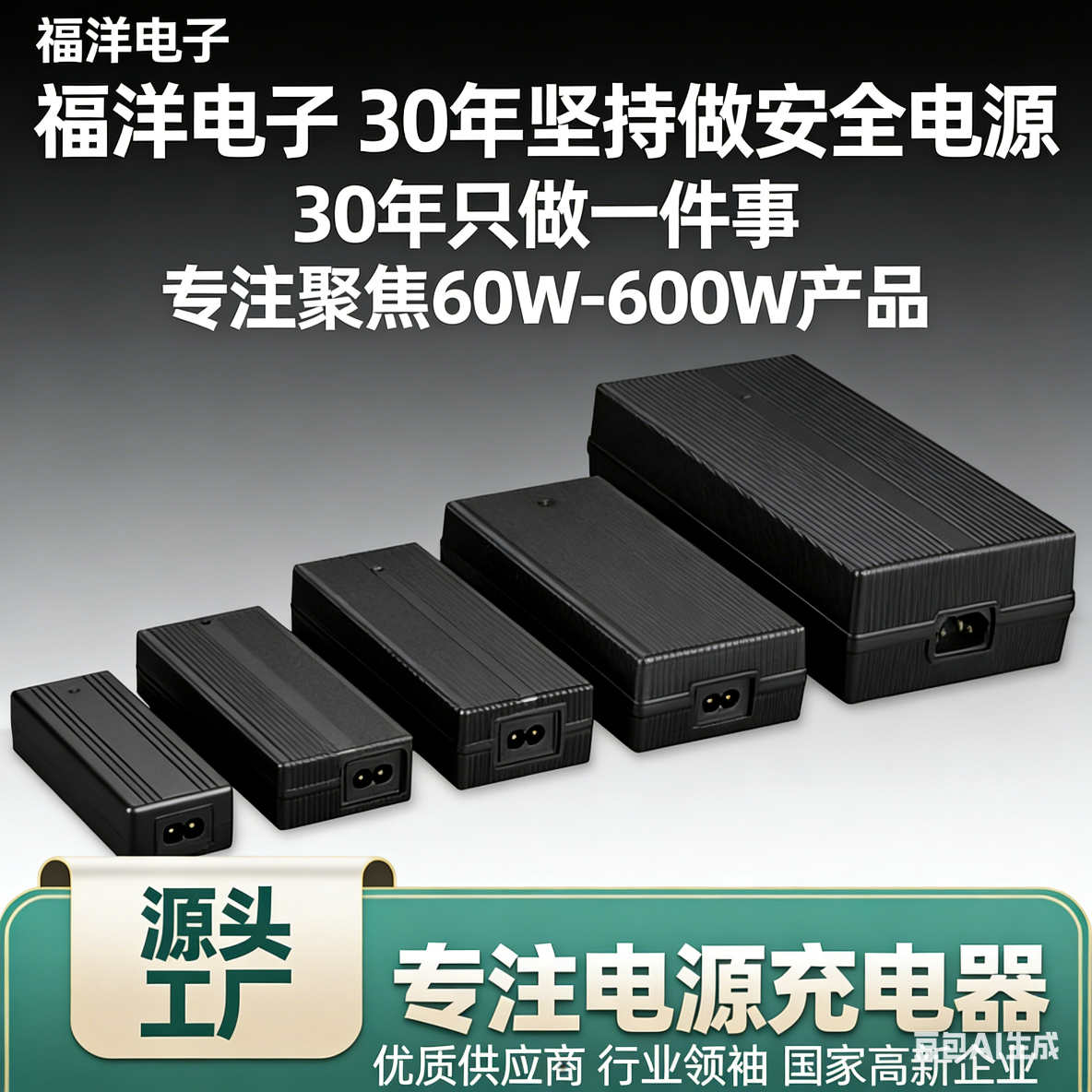
Above roughly 400 W, efficiency becomes a thermal argument. GaN/SiC platforms at 120 W, 240 W and 330 W reach up to 95% conversion efficiency, which means less waste heat for the same output. Free-air convection cooling removes the fan and its intake filter, an advantage in cells where grinding dust, coolant mist or metal particles would clog a filter in weeks. The trade-off is mounting clearance, so check the specified free space around the enclosure.
Where several robots share a docking area, multi-output units reduce the number of mains drops and cabinets. A 160 W dual-output charger serves two packs with fully independent channels, and a 1000 W four-output unit handles four at once. Independent channels matter: a shared rail lets one full pack hold back the others, which stretches the total charge time.
Chargers with CAN 2.0 or RS485 interfaces report voltage, current, temperature and fault status to the cell controller or fleet software. That data lets maintenance compare charge curves across units and catch a weak pack before it stalls a shift. Legacy protocol gateways are available for cells built around an older controller.
Tip: If the cell already has a PLC or fleet manager, confirm the communication interface during the RFQ stage. Retrofitting a bus to a charger after installation is far more expensive than ordering it once.
A factory charger is only as useful as its failure behaviour. The protection set on Fuyuan industrial platforms covers short circuit, overcurrent, overvoltage, over-temperature and reverse polarity, with automatic cutoff at full charge and an optional charge timer. Fuses sit on both the input and the output, so a fault on the battery side does not reach the mains. Operating temperature spans −29 °C to +45.5 °C with storage from −40 °C to +75 °C, which suits unheated warehouses and plant rooms.
Every unit passes 100% factory inspection and a 4–8 hour full-load burn-in, with MTBF rated at 30,000 hours or more and a 3-year warranty behind it. Fuyuan runs a CNAS-standard in-house EMC laboratory for conducted and radiated emissions, harmonics, ESD, surge and fast transient testing, plus RoHS screening, so compliance work starts before the design is frozen rather than after a failed external test.
Match the certificate to the installation site: UL, cUL, ETL and FCC for North America; CE (EMC and LVD), TUV-GS and CB for Europe; UKCA for the United Kingdom; PSE for Japan; KC and KCC for Korea; SAA and RCM for Australia and New Zealand; CCC for China; BIS for India; NOM for Mexico. RoHS and REACH declarations cover the materials side. Plant-level programmes also expect ISO 9001, ISO 14001 and QC 080000, all of which Fuyuan holds, along with BSCI social compliance.
Tip: Ask for the certificate numbers rather than a logo sheet, then verify them on the issuing body's database. It takes ten minutes and prevents a line stoppage during an audit.
Industrial charging comes down to matching a charge profile to a duty cycle, then proving the unit survives the environment it sits in. Verify the thermal design, the protection set, the bus interface and the certificates for the destination market — in that order. For reliable products and expert support, Fuyuan Electronic offers high-quality industrial robot battery chargers engineered for continuous duty, with OEM/ODM projects starting at a 100-unit MOQ and design-to-engineering turnaround as fast as 10 days.
A: Match the charger's voltage window to the pack, not to the mains. Most Fuyuan platforms cover 8–87 V DC, and the 3000 W IP67 unit offers 35–87 V with up to 35 A. Confirm the exact constant-voltage point and current limit with the battery supplier before ordering.
A: Yes, if the outputs are independent. A 160 W dual-output charger supports two packs and a 1000 W four-output unit supports four, each with its own regulation loop, which avoids the cross-talk that slows shared-rail designs.
A: Through free-air convection cooling and high-efficiency topologies. GaN/SiC models at 120 W, 240 W and 330 W convert at up to 95% efficiency, reducing the waste heat the enclosure must dissipate. Leave the mounting clearance specified in the datasheet.
A: CE marking under the EMC and Low Voltage Directives is the baseline, with TUV-GS and CB reports commonly requested by integrators and UKCA for the United Kingdom. Fuyuan provides certificate numbers for verification.
A: MOQ starts at 100 units. OEM/ODM projects cover custom functions, housing, private labelling and logo printing, with design-to-engineering work as fast as 10 days. Sample policy and payment terms are confirmed by the sales team for each project.


