Views: 0 Author: Site Editor Publish Time: 2026-05-21 Origin: Site


An industrial robot that runs three shifts a day rarely fails because of its battery. It fails because the charger was specified for a quiet warehouse office rather than a welding cell: it overheats under continuous load, trips the branch breaker when the fleet returns at shift change, drifts on its communication bus in a noisy electrical environment, or ages out inside eighteen months. This guide breaks down those four failure modes and what an industrial robot battery charger needs in order to survive them.
Fast charging a large traction pack means a lot of current through a small box. When a charger runs hot, control logic pulls back the output current to protect itself, and the charge cycle quietly stretches from two hours to four. In a plant running a fixed number of spare batteries, that lost time turns directly into idle robots.
The answer is efficiency, not a bigger fan. Wide-bandgap switching devices cut the losses that become heat in the first place, and free-air convection cooling removes the fan as a wear item.
Twenty AMRs docking at the same time draw a steep, near-simultaneous load. If none of the chargers coordinate, the panel breaker carries the sum of every inrush and current ramp on the circuit, and it trips.
The fix is scheduling at the charger level. Units with CAN 2.0 or RS485 interfaces can stagger start times, queue batteries and balance load across the circuit, so the site's electrical infrastructure stays within its rating while the fleet still leaves fully charged.
Motor drives, inverters and welding equipment throw conducted and radiated noise across the plant floor. A charger with marginal filtering can misreport battery voltage, drift on its bus, or disturb nearby sensors when it switches. Charging control loops that depend on clean voltage feedback are the first to suffer.
Filter design and layout matter more than a single component choice. Fuyuan tests complete designs in its own CNAS-standard EMC laboratory — conducted and radiated emissions, harmonics, ESD, surge and fast transient bursts — so interference problems surface before a unit reaches a customer site.
A charger that stays at full load for 20 hours a day ages on a different curve than one used for an hour at home. Electrolytic capacitors dry out, thermal cycling fatigues joints, and vibration from nearby machinery does the rest.
Build quality shows up in the numbers: multiple mating cycles, a rated MTBF of 30,000 hours or more, and 4–8 hours of full-load burn-in on every unit before it ships rather than a spot check on a sample.
Tip: Ask for the de-rating curve, not just the rated output. It tells you how much current is still available at 45°C inside an enclosure, which is the number that decides your charge cycle time.
Gallium nitride and silicon carbide switching let a charger hit higher efficiency in a smaller envelope, which in turn lowers case temperature at the same output. Fuyuan's GaN/SiC models sit at 120W, 240W and 330W with efficiency up to 95%, and the wider standard range runs from 60W to 10KW, so a mobile robot platform and a fixed charging station can draw from the same supplier family.
The list to compare: short circuit, overcurrent, overvoltage, over-temperature, reverse polarity, automatic cut-off at full charge, and a timer function to stop charging when a pack does not reach its end-of-charge condition. Dual fusing on input and output is worth confirming as well — fuses on one side only leave the other side unprotected.
Plastic or aluminium housings are both available, and fanless free-air convection cooling keeps dust and grease out of the airflow path while eliminating noise and a moving part. Standard operating range is −29°C to +45.5°C with storage from −40°C to +75°C; where washdown or outdoor docking applies, IP67 versions are available in several power classes.
Tip: Match the output voltage window to the battery management system on the robot before ordering. An 8–87V adjustable range covers most industrial packs, but the BMS handshake requirements are what decide whether the robot accepts the charge.
Industrial sites usually have a global safety policy, so the approval list matters at the specification stage: UL, cUL, ETL, FCC, TUV-GS, CE (EMC and LVD), CB, UKCA, PSE, KC/KCC, SAA, RCM, CCC, NOM and BIS, with RoHS and REACH documentation for material compliance.
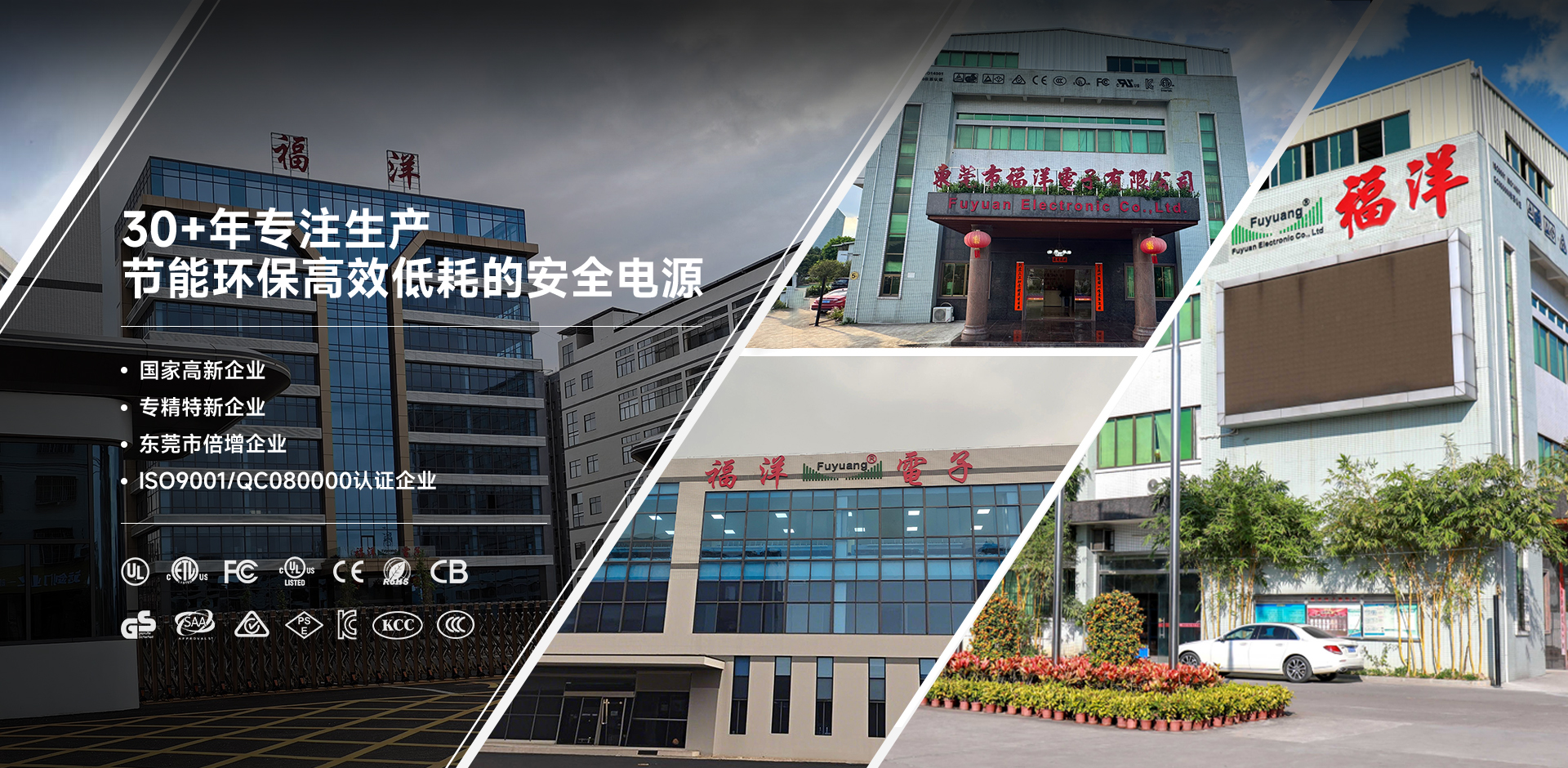
Fuyuan Electronic was founded in 2005, employs 450 people and runs two production bases in Dongguan and Yongzhou, Hunan, covering 108,000 m². Manufacturing is covered by ISO9001, ISO14001, QC080000 and BSCI; industrial chargers carry a 3-year warranty, and every unit is subject to 100% factory inspection with 4–8 hours of full-load burn-in. For fleets that need a non-standard voltage or a multi-port charging cabinet, OEM/ODM development runs from concept to engineering in as little as 10 days, with a 100-unit minimum order quantity.
Service matters as much as the specification when robots cannot stop. Chargers from Fuyuan Electronic are in service with more than 28 named global brands across robotics, automation and mobility, among them Unitree, AGIBOT, UBTECH, Pudu and iRobot. Order details and programme specifics stay confidential.
Heat, tripping, interference and wear are not random. Each one traces back to a decision made at specification: efficiency class, scheduling capability, filter design and duty-cycle testing. Get those four right and the charger stops being the weakest link in a 24-hour operation.
For reliable products and expert support, Fuyuan Electronic offers high-quality industrial robot battery chargers engineered for continuous duty, from 60W platforms up to 10KW custom designs, with CAN 2.0 and RS485 monitoring and a 3-year warranty.
A: Stagger the starts. Chargers with CAN 2.0 or RS485 can queue batteries and sequence the ramp-up so simultaneous inrush does not stack on one circuit, and a load-balanced schedule keeps peak demand inside the panel rating.
A: Yes, provided the design is efficient enough. Free-air convection cooling suits filtered, dusty or noise-sensitive plants, but it depends on a low-loss topology; check the de-rating curve against the real ambient temperature inside your cabinet.
A: Standard platforms cover 60W to 3000W, with the wider engineering capability reaching 10KW. More than 3,000 models have been developed, so a matching or close-to-matching platform usually already exists.
A: Chargers with CAN 2.0 or RS485 interfaces can report status and accept scheduling commands, which is what allows charge sequencing and load balancing across a site. Protocol details should be confirmed against your fleet management layer during specification.
A: Design-to-engineering turnaround runs as fast as 10 days under an OEM/ODM programme. Production schedules depend on the model and order volume and are confirmed on the proforma invoice.


