Views: 0 Author: Site Editor Publish Time: 2026-04-20 Origin: Site


Restaurant automation is rarely limited by the robot. It is limited by the twenty minutes the robot spends off the floor with a low battery, the dock it failed to engage during the lunch rush, or the charger that gave up after a year of grease and steam. F&B operators are not buying a power supply — they are buying service hours, and a food service robot charger should be selected on that basis.
Two service peaks a day define the load profile. Between them there is a long, quiet window and a handful of short gaps when the robot is parked while the kitchen catches up. How well a charger exploits those fragments determines whether the robot finishes the evening on 40% or on empty.
A constant-current/constant-voltage profile matters here because the first phase puts the most charge in fastest. If the charger reaches its voltage plateau quickly, a fifteen-minute charge can return a useful slice of capacity; if the charger spends that time ramping up slowly, the same fifteen minutes buys very little.
Service aisles are narrow, floors are uneven, and the robot has to find the same position dozens of times a day. Contact resistance creeps up as plates wear, and an intermittent connection during the constant-voltage phase ends charging early. The charger's own logic matters: units that verify the connection before applying current and re-initiate a cycle after a dropout keep robots in service instead of parked with a fault indication.
Kitchens and back-of-house corridors are wet, oily and regularly washed down. Cooling fans pull that air through the enclosure and deposit it on the boards. Enclosure rating and material choice — sealed housings, oil-resistant cable jackets, no exposed airflow path — do more for service life in a restaurant than any electrical specification.
Tip: Site the dock away from the dishwashing pass. The single most common cause of premature charger failure in food service is a dock installed where the air stays saturated.
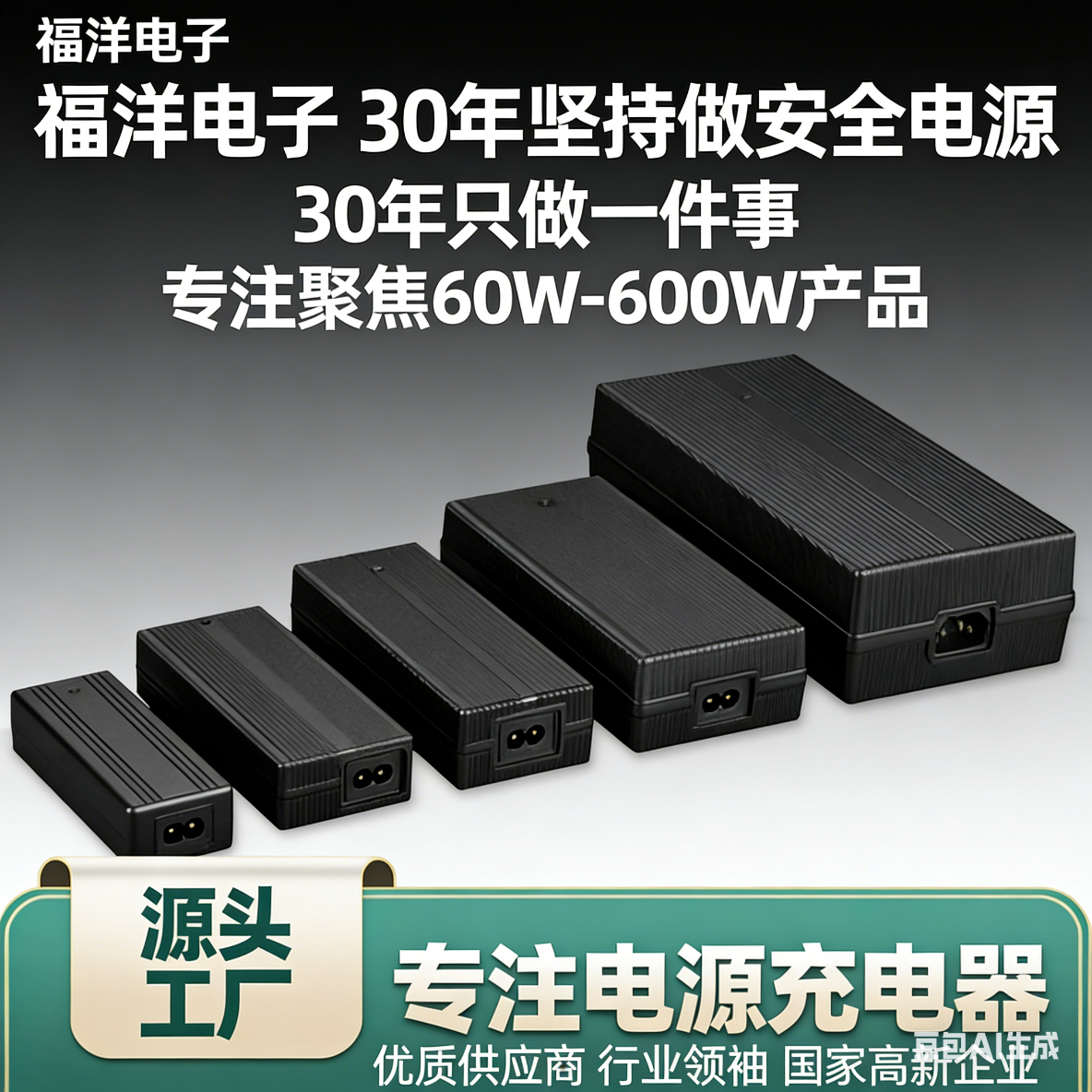
Lithium-ion and LiFePO4 packs both suit CC-CV charging, with the charger holding current through the bulk phase and tapering to a cut-off point at full charge. Temperature sensing and automatic shut-off protect the pack when a robot returns hot from a long run, and a timer function stops the cycle if end-of-charge is never reached.
Back-of-house space is scarce, and running a separate charger and cable for every robot adds clutter to areas that already get washed down. Multi-output designs — two independent outputs or four — let one enclosure serve several robots. The outputs are electrically independent, so a single unit can charge different pack voltages without cross-talk.
In larger venues, charging stops being a per-robot decision. CAN 2.0 and RS485 interfaces allow chargers to queue robots, stagger charge starts and report state of charge, so eight robots coming off shift do not all pull current at once. That also protects the building's electrical capacity, which is a real constraint in older restaurant fit-outs.
Tip: Map the service day before choosing charger power. A 600W charger and a 2-hour window usually beats a 300W charger running all night, and it frees the robot for the morning shift.
Confirm the pack chemistry and BMS handshake before ordering — this decides compatibility more than the connector does.
Specify an enclosure rating that survives washdown and a housing material that resists oil and cleaning agents.
Check the protection list: overvoltage, overcurrent, short circuit, over-temperature, reverse polarity, full-charge cut-off and timer charging.
Ask for the certification package for every market in the rollout — CE, UKCA, UL, cUL, ETL, PSE, KC, SAA, RCM, CCC as applicable.
Confirm service terms: a 3-year warranty, MTBF of 30,000 hours or more, and 100% factory inspection with 4–8 hours of full-load burn-in.
Standardise on one charger family across sites so spare units and training are shared.
Fuyuan Electronic has manufactured power supplies since 2005 and operates two production bases in Dongguan and Yongzhou, Hunan, with 108,000 m² of floor space and 450 employees. Standard platforms span 60W to 10KW with more than 3,000 models developed, and the company runs its own CNAS-standard EMC laboratory alongside ISO9001, ISO14001, QC080000 and BSCI system certification. Custom service robot chargers are delivered through OEM/ODM programmes with design-to-engineering turnaround as fast as 10 days and a 100-unit minimum order quantity.
In food service, charger quality shows up as service hours. Choose a unit whose charging profile fills the quiet gaps quickly, whose housing survives a washdown, and whose scheduling can keep a fleet from all drawing power at once — then measure dock success rate monthly rather than waiting for a failure report from the floor.
For reliable products and expert support, Fuyuan Electronic offers high-quality food service robot chargers engineered for restaurant environments, with CC-CV charging profiles, multi-output options, CAN 2.0 and RS485 fleet scheduling and a 3-year warranty.
A: It depends on pack capacity and the charger's output current. A CC-CV charger delivers most of its charge during the constant-current phase, so a short partial charge returns a useful amount of capacity; the exact figures should be calculated from your pack rating and duty cycle.
A: They need a sealed housing and materials that tolerate grease, water and cleaning chemicals. Open-frame or fan-cooled designs draw contaminated air across the electronics and fail earlier in kitchens and washdown areas.
A: Yes, with a multi-output charger. Two or four independent outputs let one enclosure charge several robots, or several pack voltages, from a single installation point, and scheduling over CAN 2.0 or RS485 keeps the load within the circuit rating.
A: Safety and EMC approvals for the destination market are the starting point — CE and UKCA for Europe, UL, cUL and ETL for North America, plus PSE, KC, SAA/RCM and CCC in other regions, with RoHS and REACH material declarations.
A: Chargers carry a 3-year warranty, and technical support is available throughout the deployment. For multi-site rollouts, charger configuration and deployment planning can be handled through the OEM/ODM programme.


