Views: 0 Author: Site Editor Publish Time: 2026-07-17 Origin: Site


Two problems end electric scooter exports more often than anything else: a charger without the approvals the destination market demands, and a charger that cannot survive the back of a van. Both show up late, after the container has shipped, when a customs hold or a warranty claim is already in progress. Building the electric scooter charger into the product plan rather than adding it at the end avoids most of that.
Scooter regulations differ by region, and the charger sits inside them. North America applies vehicle-level standards such as UL 2272 to the scooter's electrical system, while the charger itself needs its own listing. Europe requires CE marking under EMC and LVD, the UK uses UKCA, Japan requires PSE, Korea uses KC, and Australia and New Zealand use SAA and RCM. RoHS and REACH declarations are expected in most of those markets.
Fuyuan chargers ship with UL, cUL, ETL, FCC, TUV-GS, CE (EMC and LVD), CB, KC, KCC, PSE, SAA, RCM, UKCA, CCC, NOM and BIS certifications already in place. A brand selling the same model in Europe, North America, Japan, Korea and Australia does not have to run a separate charger approval for each destination, and the documentation package is ready for customs review.
The most common certification failure on a small power supply is conducted or radiated emissions. Fuyuan tests filter and layout changes in its own CNAS-standard EMC laboratory, which covers conducted and radiated emissions, harmonics, ESD, surge and fast transients, before a design is submitted to a third-party house. Catching the problem internally keeps the certification schedule predictable, which is the part of an export launch that is hardest to recover once it slips.
Tip: Ask for the certificate numbers before you place the production order, not after. Verification is quick when the paperwork exists.
A scooter charger spends its life in motion. It is folded into a deck bag, thrown into a van, and plugged in on a cold street or a dusty trailhead. Solder joints work loose and enclosures crack under that treatment if the unit was designed for a desk.
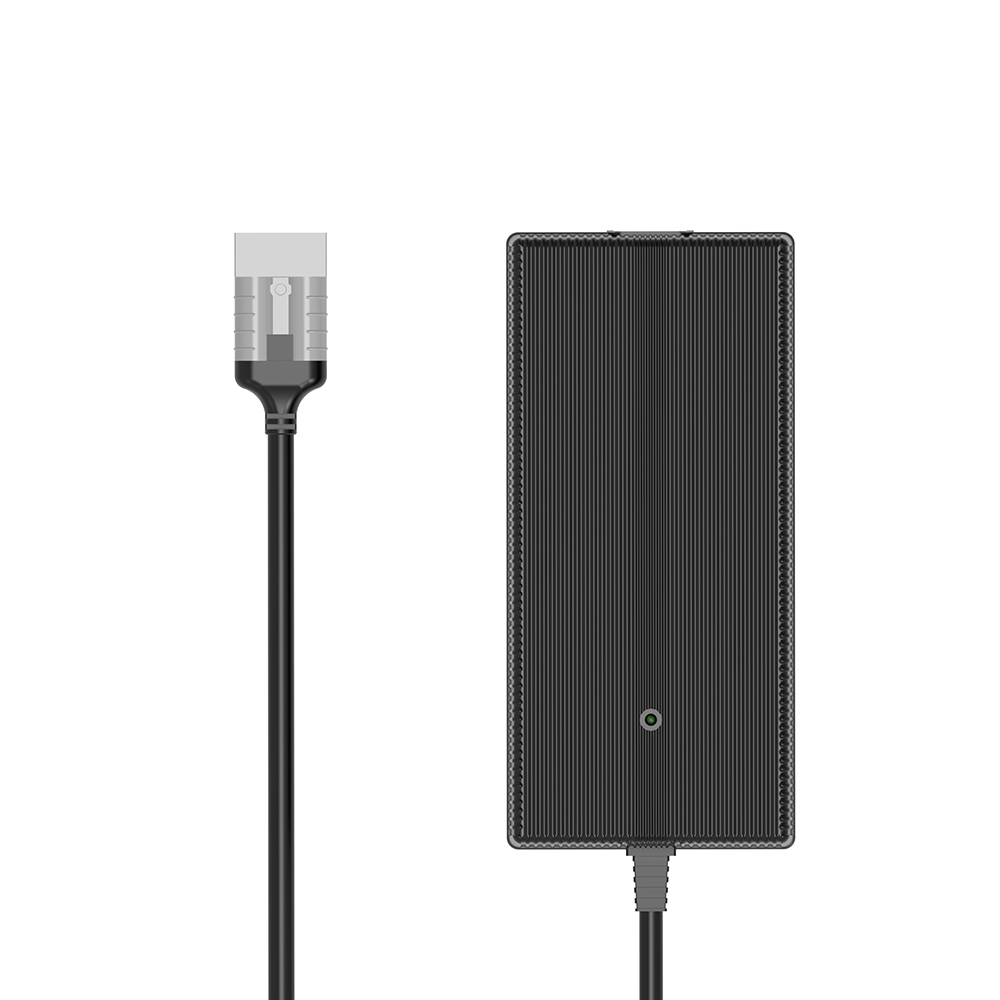
Fuyuan builds the internal assembly with vibration-resistant retention and validates units through continuous shake testing before release. Housings use low-temperature modified plastics that stay intact when the charger is left in a vehicle overnight at −20 °C, and aluminum housings are available where impact resistance is the priority. Output connectors are available in dozens of types — XT60, XT90, Anderson, aviation plugs and barrel connectors among them — so the charger matches the pack on the scooter rather than the other way round.
Outdoor and off-road models are upgraded to IP54 dust and splash protection, and the platform extends to full IP67 sealed units for equipment that is stored outside permanently. Standard units are rated to operate from −29 °C to +45.5 °C, covering cold-morning charging as well as summer sun.
Tip: Decide the ingress level by storage, not by riding conditions. A charger kept in a wet shed needs more protection than one carried in a dry case.
Scooter packs run across 24 V, 36 V, 42 V and 48 V systems, and retailers often carry several at once. Buying a separate charger for each voltage locks up working capital in slow-moving inventory.
Fuyuan develops lithium-ion and lead-acid charging programs on shared hardware platforms, with output voltage, current limit, cutoff point and connector configuration set by firmware and assembly options. One part number can cover several scooter models, and interface or output power changes can be handled at small volume. The company has developed more than 3,000 charger models between 60 W and 10 kW, which makes it straightforward to find an existing platform close to a new requirement.
Retail customers eventually plug the wrong plug into the wrong socket. Every scooter charger carries overvoltage, overcurrent, short circuit, reverse polarity, over-temperature and electric shock protection, with fuses on both input and output. Reversed polarity ends in a shutdown rather than a burnt pack, which is the difference between a service email and a product liability claim. Automatic detection of battery voltage and polarity, current lock and automatic cutoff at full charge are standard across the range.
Tip: Standardize on one connector family across your scooter line if the frames allow it. Mismatched plugs are the most common cause of reverse-polarity returns.
Cross-border after-sales support is expensive per unit because shipping a replacement costs as much as the part. Two things reduce that cost: reliability in the field and a warranty that is long enough to cover the realistic failure window. Fuyuan units run through 4 to 8 hours of full-load burn-in and 100% factory inspection, with MTBF documented at 30,000 hours or more, and carry a 3-year warranty. Custom work — output profiles, labeling, enclosure graphics and connectors — starts at 100 units, with design-to-engineering cycles running as fast as 10 days. Production is split across two bases in Dongguan and Yongzhou, Hunan, with 108,000 m² of manufacturing space and 450 employees.
Tip: Keep a small stock of spare chargers at the destination market. It is cheaper than air-freighting single units to consumers.
Exporting scooters profitably comes down to shipping products that clear customs and stay working. Approvals that cover the destination markets, mechanical construction that survives transport, and firmware flexibility that keeps inventory lean do most of that work. Retailers carrying multiple voltage classes often find the same hardware platform covers several models — see the full range at battery charger products. For reliable products and expert support, Fuyuan Electronic offers high-quality electric scooter chargers engineered for road use, supplied with multi-market certification and a 3-year warranty.
A: Typically the safety certificate for the destination market, an EMC report, RoHS and REACH declarations, and a product label carrying the required marking. Fuyuan supplies these as a standard documentation package with every certified model.
A: No. Voltage classes are not interchangeable, and the BMS will either refuse the charge or the charger will be damaged. What does work is sharing one hardware platform across voltages with firmware variants, which keeps the part count down without mixing incompatible units.
A: At minimum, overvoltage, overcurrent, short circuit, reverse polarity and over-temperature protection with fuses on input and output. Automatic detection of battery voltage and polarity adds a layer that prevents damage from incorrect connection.
A: They need more mechanical and environmental margin. Vibration-resistant assembly, low-temperature housing material and an upgraded ingress rating such as IP54 are worth specifying, while units stored outdoors year-round suit IP67 sealed construction.
A: The minimum order quantity is 100 units, covering custom output settings, connectors, private labeling and logo printing. Design-to-engineering work takes as fast as 10 days from confirmed specifications.


