Views: 0 Author: Site Editor Publish Time: 2026-05-21 Origin: Site


Most e-scooter failures that come back to a workshop are not motor or controller faults. They are charging faults: a pack fed the wrong voltage, a connector wired the wrong way round, or an output board that cracked after a season of kerb-side vibration. Choosing the right electric scooter battery charger is a design decision, not an accessory purchase, and it deserves the same attention as the battery management system sitting next to it.
A reversed DC plug, or a re-terminated lead fitted by a shop technician, puts full pack voltage across the charger output. Units built to a low bill of materials often leave out the reverse-polarity and over-temperature branches, so nothing obvious happens on the bench. The damage shows up weeks later as a swollen cell or a pack that will not accept charge.
Scooter and e-bike chargers from Fuyuan Electronic carry six hardware-level protections: overvoltage, overcurrent, short circuit, reverse polarity, over-temperature and shock protection. Because they sit in hardware rather than firmware, they stay active through supply sags and controller resets.
Folding models travel in car boots and get thrown into vans. Off-road boards are ridden through mud and parked in unheated garages. Repeated shock loosens through-hole parts and cracks solder fillets, and cold raises the pack's internal resistance until a marginal charger simply refuses to start a charge cycle.
Three specification points cover most of this: reinforced or potted mounting for the output stage, enclosure plastics rated for low-temperature use, and an ingress rating that matches where the charger actually lives. A dusty garage shelf needs far less than a charger that stays outdoors with the scooter.
Tip: Ask for the reverse-polarity and over-temperature test reports rather than accepting a datasheet line item. Those two branches are the easiest ones to delete from a low-cost build.
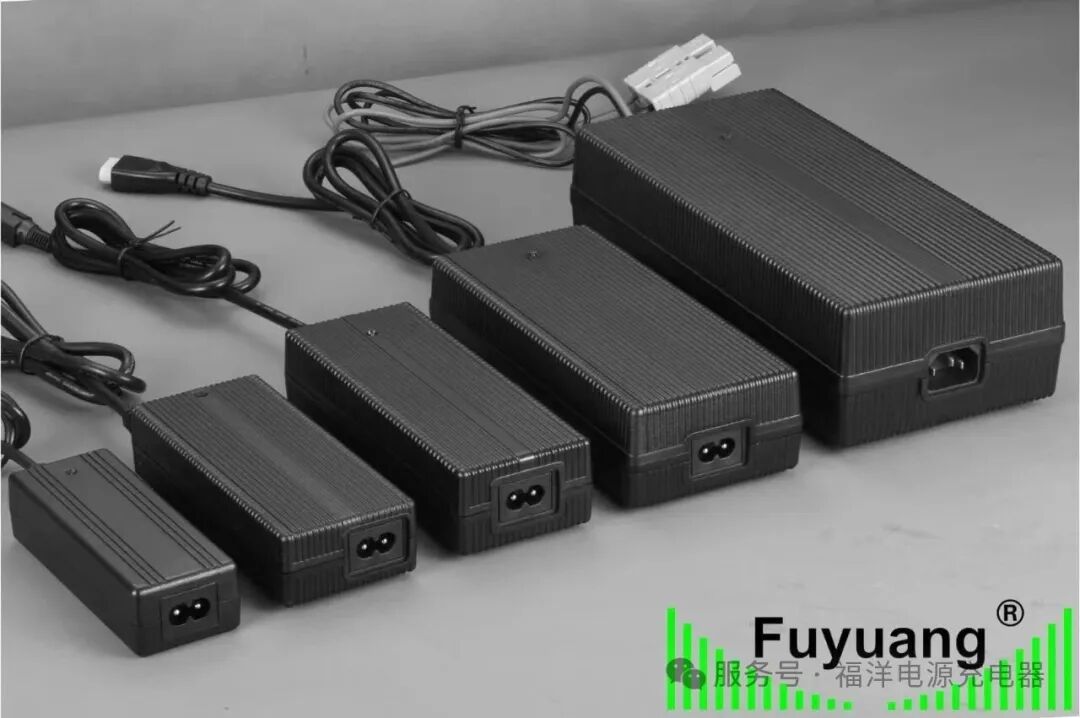
Retail scooters cluster around 24V, 36V, 42V and 48V nominal packs, and the same chassis often ships with lithium-ion in one market and lead-acid in another. What matters is the charger output window, not the marketing label on the deck.
Fuyuan's standard platforms span an 8–87V output range across 60W to 3000W, so a non-standard pack can usually be matched from an existing family rather than developed from a blank sheet. Lithium-ion, LiFePO4 and lead-acid versions are all produced, each with its own charging profile: constant-current/constant-voltage for lithium packs, three-stage for lead-acid, with temperature sensing and automatic cut-off when the pack reaches full charge.
Connector mismatch is the second most common cause of returns, and it is entirely avoidable. Standard DC interfaces run from 5.5 x 2.5 mm barrel plugs through XT60 and XT90, Anderson, DIN, aviation plugs, crocodile clips and C13/C14 inlets, with 35 options in the catalogue. The AC side covers 15 plug types, including EU, UK, US, JP, AU, CN, India, Brazil, South Africa and Israel.
For retail programmes, a single charger plus a short adapter cable is often a better answer than three separate SKUs: a 5.5 x 2.5 mm output paired with conversion leads covers a wide spread of scooter models without carrying three product lines in the warehouse.
Brands that run proprietary packs, unusual voltages or a specific connector footprint can specify a custom variant with OEM/ODM support. Design-to-engineering turnaround runs as fast as 10 days, and the minimum order quantity is 100 units, which keeps the entry point low for a first production run.
Tip: Send the pack datasheet and a sample connector, not a photo. Charge voltage tolerance, maximum charge current and connector polarity are the three items that most often differ between a sample and the drawing.
Export programmes stall when the power accessory has no approvals of its own. Chargers can be supplied already certified for the target market: CE (EMC and LVD), UKCA and CB for Europe and the UK; UL, cUL, ETL and FCC for North America; PSE and KC/KCC for Japan and Korea; SAA and RCM for Australia and New Zealand; CCC for China; plus NOM and BIS for Mexico and India. RoHS and REACH documentation travels with the shipment.
That matters beyond paperwork. A scooter brand shipping into five countries can keep one charger design in the BOM instead of five.
Every unit is inspected before it leaves the line, with 4–8 hours of full-load burn-in on the production floor and a rated MTBF of 30,000 hours or more. Fuyuan builds 60W to 10KW products and has developed more than 3,000 models, with 450 staff across two production bases covering 108,000 m² in Dongguan and Yongzhou, Hunan. The company was founded in 2005 and holds ISO9001, ISO14001, QC080000 and BSCI certification.
An in-house CNAS-standard EMC laboratory handles conducted and radiated emissions, harmonics, ESD, surge and fast-transient testing alongside RoHS screening, so a new scooter programme can be pre-tested before it goes to a third-party lab. Scooter chargers carry a 3-year warranty.
Tip: Book EMC pre-compliance slots before the enclosure tooling is cut. Emissions problems are cheap to fix on a bench and expensive to fix on a mould.
A scooter charger that is specified properly — correct voltage window, protected output, vibration-tolerant construction and approvals for every market you sell into — removes an entire category of field returns and warranty claims. Start from the pack's charge voltage and chemistry, then work outward to the connector, the enclosure rating and the certification package.
For reliable products and expert support, Fuyuan Electronic offers high-quality electric scooter battery chargers engineered for daily portable use, with global certifications, in-house EMC testing and a 3-year warranty.
A: No. A 48V charger on a 36V pack will overcharge it, and a 36V charger on a 48V pack will never reach full charge. What can be shared is the connector — an adapter cable lets one charger cover several brands, provided the output voltage and current profiles match the pack.
A: Ask for the test report, not just the specification sheet. A protected output will survive a deliberately reversed connection at the DC plug without drawing current or damaging the output stage, and the report should show the test conditions used.
A: IP67 means the enclosure is dust-tight and withstands immersion in about one metre of water for 30 minutes under defined test conditions. It is not a licence to charge underwater or to leave a connector mated in standing water, so the installation instructions still matter.
A: Yes. Custom voltages, current settings, DC interfaces and branded housings are all supported through OEM and ODM programmes, with design-to-engineering turnaround as fast as 10 days and a 100-unit minimum order quantity.
A: UL, cUL, ETL, FCC, TUV-GS, CE (EMC and LVD), CB, UKCA, PSE, KC/KCC, SAA, RCM, CCC, NOM and BIS, plus RoHS and REACH. Tell us the destination markets at the quotation stage and the matching approval package can be confirmed for that model.


