Views: 0 Author: Site Editor Publish Time: 2026-07-29 Origin: Site


Chargers are a recurring root cause of e-scooter after-sales claims, and the same three patterns keep surfacing: no mandatory safety approval, no reverse-polarity hardware, and weak tolerance to vibration and cold. Returns data from cross-border sellers and customs refusals point in the same direction, which is why Dongguan Fuyuan Electronic builds its electric scooter battery charger range around compliance, weather tolerance and battery compatibility rather than price alone.
A charger that fails customs is not sold product — it is inventory sitting in a container. The United States requires e-mobility electrical systems to meet the UL 2272 standard, Europe enforces CE-LVD and EMC directives, and Australia and Japan each apply their own approval routes through SAA and PSE. For a smaller brand, testing one power supply design across several markets can consume months and a significant portion of the launch budget.
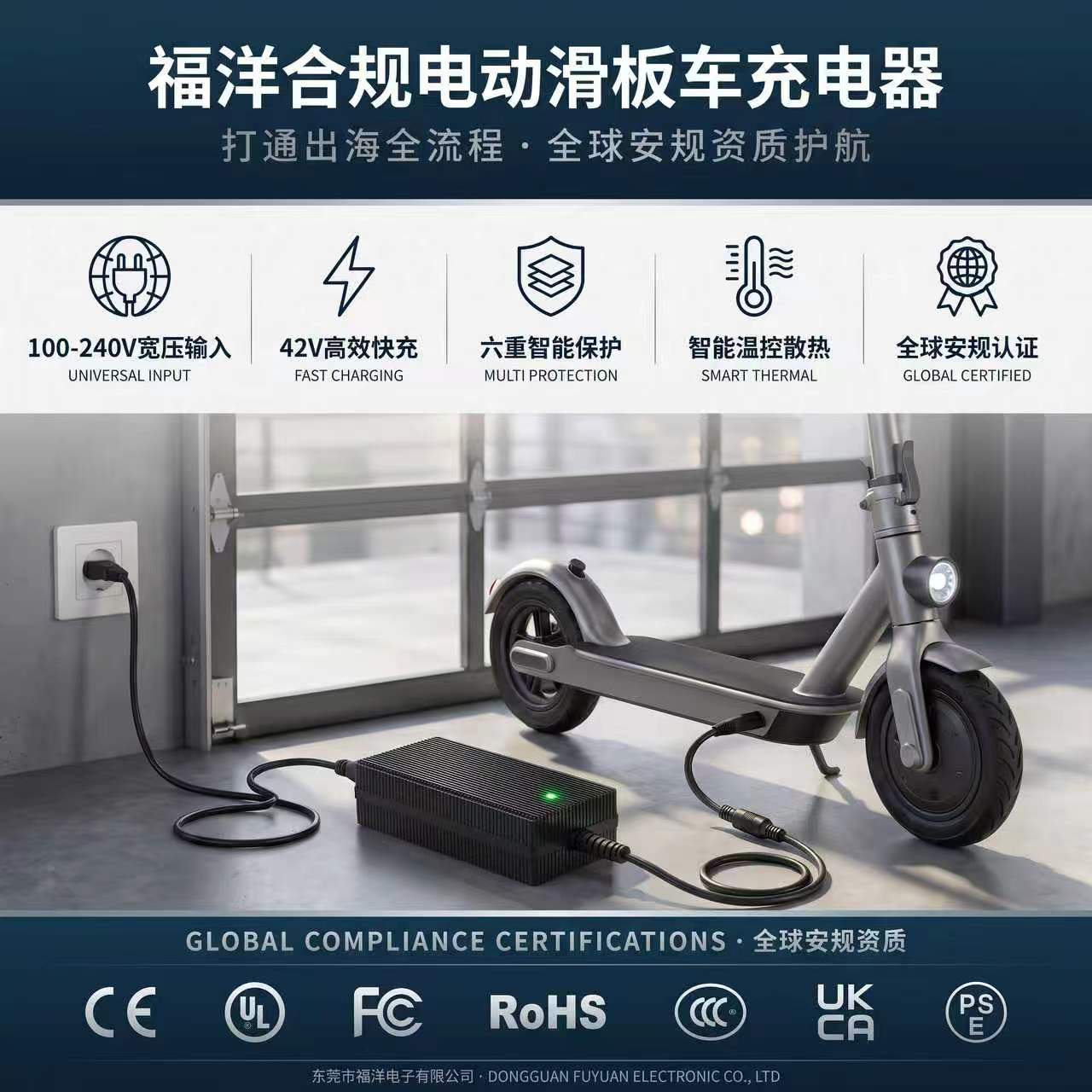
Fuyuan completes the full set of mainstream safety approvals for its e-scooter charger range in advance, together with RoHS and REACH environmental compliance. The certification documentation ships with the goods, so a complete scooter can clear customs without a second power-supply test round. Because the company runs its own CNAS-level EMC laboratory, filtering circuits can be tuned for a specific destination market before the design is frozen, which reduces the chance of a radiated or conducted emissions failure at the accredited test house and protects the launch window.
Tip: Ask for the certificate numbers and the standards they cover, not just the logos on the label. Check the issuing body's public register before you commit to a purchase order.
A folding scooter charger spends more of its life in a car boot than on a shelf. Long-distance transport shakes it continuously, and winter riding means a charger that has been sitting below freezing starts charging a battery that is also cold. Solder joints on a lightly built board crack, and low-temperature charging current drops away.
Internal anti-vibration filling and anchored components, validated through hundreds of hours of vibration and ageing testing.
Modified flame-retardant housing material that allows a stable charge start at −20°C.
IP65 dust and moisture sealing on off-road models, so road dust and light rain do not reach the circuits.
Six hardware protections as standard: over-voltage, over-current, short circuit, reverse polarity, over-temperature and shock protection.
Reverse polarity deserves particular attention. When a user connects the leads the wrong way round, the charger must cut its output immediately. On units without that hardware, the mistake ends with a damaged battery pack, a customer complaint and a review that affects the whole listing.
Tip: Run a cold-start test at −20°C and a reverse-polarity test on the units you receive. Both take minutes and reveal whether the protection is hardware or only printed in the manual.
Scooters on the market run across 24V, 36V, 42V and 48V systems, and the packs themselves may be lithium ternary, lead-acid or NiMH. Stocking a separate charger for every combination ties up working capital and warehouse space, and slow-moving SKUs are the ones that age on the shelf.
Fuyuan splits the range into two standardized hardware platforms — one for lithium-ion chargers and one for lead-acid chargers — and adapts a single platform to multiple scooter models by changing the internal charging programme. That compresses the brand's stocking list to a manageable number of variants. Output connector, cable and housing appearance can still be customized in small batches to match a brand's own design language.
Production runs across the Dongguan and Hunan bases, with flexible lines that handle both small and large orders. Technical enquiries are handled by an engineering team led by a specialist with more than three decades in power electronics, and every e-scooter charger carries a 3-year warranty with circuit-level optimization and replacement options for after-sales cases. Across the wider catalogue the company has developed more than 3,000 models from 60W to 10KW, so unusual voltage or current requirements usually have an existing platform behind them.
Tip: List the battery voltages and chemistries you actually sell, then ask how many charger part numbers are required to cover them. A two-platform approach is usually enough for a full e-scooter line-up.
Cross-border e-mobility competition has moved past the stage where an uncertified, lightly built charger can ride along with a good scooter. Approvals, weather tolerance and inventory efficiency decide whether a listing survives its first winter. For reliable products and expert support, Fuyuan Electronic offers high-quality battery chargers engineered for continuous duty, with multi-market certification, IP65 and IP67 protection options and a 3-year warranty.
A: It depends on the market. The United States applies the UL 2272 standard to e-mobility electrical systems, Europe enforces CE-LVD and EMC requirements, while Australia and Japan apply SAA and PSE. RoHS and REACH apply to materials and substances. Fuyuan completes the mainstream approvals for its e-scooter charger range in advance and ships the documentation with the goods.
A: Components are anchored and anti-vibration filled, and the modified flame-retardant housing allows a stable charge start at −20°C. Off-road models add IP65 dust and moisture sealing for wet and dusty conditions.
A: Over-voltage, over-current, short circuit, reverse polarity, over-temperature and shock protection are standard across the range, so a reversed connection cuts the output instead of damaging the battery pack.
A: Yes. Fuyuan maintains two standardized hardware platforms, one for lithium-ion and one for lead-acid batteries, and adapts them to different models through the internal charging programme, which reduces the number of charger part numbers a brand has to stock.
A: Yes. Output connectors, cables and housing appearance can be customized in small batches, and OEM/ODM projects support private labeling and logo printing with an MOQ of 100 units.


