Views: 0 Author: Site Editor Publish Time: 2026-07-17 Origin: Site


Long-range e-bikes put more demand on a charger than commuter models do. A 500 Wh to 900 Wh pack built from high-energy cells spends hours at a time on charge, and its owner notices every fault: a pack that runs warm, a cut-off that arrives early, a battery that loses range after two winters. For OEMs, the charger is also where compliance and inventory decisions get made, not an accessory added at the end of the bill of materials. This is the case for treating the electric bike battery charger as a designed subsystem.
A generic charger applies one constant-voltage output to whatever it is plugged into. That works until the pack is an NMC or LFP assembly with specific voltage, current and temperature limits written into its BMS.
Nickel-rich packs finish at a higher cell voltage and tolerate a shorter absorption phase than lithium iron phosphate packs, which hold a flat voltage plateau and then rise sharply at the end. Charging both with the same profile leaves one underfilled or the other held too long at high voltage. Fuyuan develops separate CC-CV programs for each chemistry, so the taper rate, cutoff point and current limit follow the cells in the pack.
Charge acceptance falls with temperature. A pack left in an unheated garage overnight cannot absorb the current it takes at 25 °C, and pushing it anyway costs capacity over the following seasons. Fuyuan chargers read pack or ambient temperature and reduce current when it drops, then restore the standard rate as conditions improve. The same sensing works in the other direction, cutting power when a pack runs hot after a long ride.
Cell voltage and temperature are logged throughout the cycle, and charging stops if one cell diverges from the rest. Automatic detection of battery voltage and polarity means an incorrect connection ends in a shutdown rather than a damaged pack. Automatic cutoff at full charge and optional timed charging keep the pack off the charger rail overnight.
Tip: Specify the charge curve by chemistry and pack voltage, not by wattage alone. Two 48 V packs can need different profiles.
A charger that is not approved for a market is a shipment that stops at customs. For brands selling the same frame in Europe, North America, Japan, Korea and Australia, power supply approvals are the item that most often delays a product launch.
Fuyuan chargers are certified to UL, cUL, ETL, FCC, TUV-GS, CE (EMC and LVD), CB, KC, KCC, PSE, SAA, RCM, UKCA, CCC, NOM and BIS, with RoHS and REACH declarations for material compliance. When the whole vehicle is assembled and shipped, the charger documentation is already in place, so no second round of power supply testing is needed for each destination.
Emissions problems are easier to fix in the lab than in a certification queue. Fuyuan's in-house CNAS-standard EMC laboratory covers conducted and radiated emissions, harmonics, ESD, surge and fast transients, and the company holds ISO 9001, ISO 14001, QC080000 and BSCI. Filter and layout changes can be validated internally before a design is submitted, which is where most cost and schedule risk sits in a certification program.
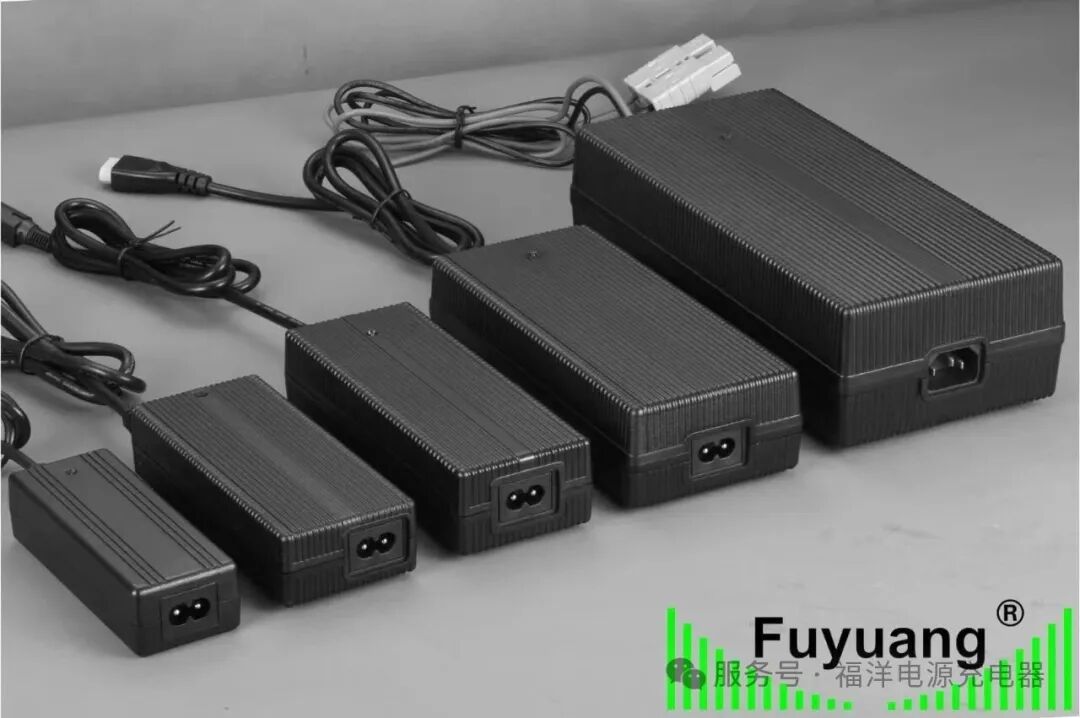
Tip: Collect the target market list before the charger spec is frozen. Approvals are cheaper to add in the design phase than after tooling.
Frame revisions are routine in the e-bike business: a new battery mount, a different output connector, a limited-edition finish. Chargers have to follow those changes without forcing a supplier into a full production run.
Custom development at Fuyuan starts with the pack specification and the BMS communication details, then moves through circuit adaptation, sampling and reliability testing. The design-to-engineering cycle runs as fast as 10 days on confirmed specifications, and small-batch orders are accepted from 100 units, so a mid-size brand does not have to commit to volume it cannot sell. Private labeling and logo printing are standard options, and enclosures can be plastic or aluminum.
Program-level differences between battery variants do not have to become separate charger part numbers. Reprogramming one hardware platform covers different voltage limits, current settings and connector arrangements, which keeps spare-part lists short and warehouse space free. Fuyuan has built more than 3,000 charger models across a 60 W to 10 kW range, and works with OEMs that run several battery configurations on one frame. Every unit leaves the line after 4 to 8 hours of full-load burn-in and 100% factory inspection, with MTBF documented at 30,000 hours or more and a 3-year warranty behind it.
Tip: Plan charger firmware variants alongside battery SKUs. It is the simplest way to avoid a second part number.
Charger selection on a mid-range e-bike comes down to three things: a charge curve matched to the pack chemistry, approvals that already cover the destination markets, and enough flexibility to follow frame revisions without a minimum order that ignores reality. NMC and LFP versions of the same bike usually need different profiles, which is why LiFePO4 battery charger programs are specified separately from NMC units. For reliable products and expert support, Fuyuan Electronic offers high-quality electric bike battery chargers built for daily charging cycles, supplied with multi-market certification and a 3-year warranty.
A: Only if its output matches the pack's limits. The charger must respect the BMS cutoff voltage and current ceiling, and it must reduce current as temperature falls. A unit without temperature sensing will keep supplying full current in conditions where the pack cannot accept it.
A: It depends on the destination. North America generally requires UL/cUL or ETL plus FCC; Europe needs CE marking under EMC and LVD; the UK uses UKCA; Japan requires PSE; Korea uses KC; Australia and New Zealand use SAA and RCM; China uses CCC. RoHS and REACH apply across most of these markets.
A: Fuyuan's minimum order quantity is 100 units, including customized output profiles, connectors and labeling, with design-to-engineering work taking as fast as 10 days.
A: The power stage can be shared, but charging profiles cannot. Lead-acid packs use a three-stage profile with different absorption and float voltages, while lithium packs use CC-CV with a hard cutoff. Firmware variants on a shared platform keep both options open without duplicating hardware.
A: Full-load burn-in of 4 to 8 hours per unit, 100% factory inspection, MTBF documented at 30,000 hours or more, and in-house EMC and environmental testing performed before shipment.


