Views: 0 Author: Site Editor Publish Time: 2026-03-09 Origin: Site


A charger that is one voltage step off will either leave a pack stranded at 80% state of charge or push it past the point its BMS was designed to accept. Matching battery charger power and voltage is arithmetic rather than guesswork: work out the full-charge voltage of the series string, size current to the chemistry's C-rate, then add thermal margin. The same three steps apply whether you are specifying a battery charger for a handheld tool or a 1.5kW fast-charge unit for an AGV fleet.
Sizing starts with data from the battery pack, not from the charger catalogue. Nominal voltage alone is not enough. A 48V lithium pack is usually 13 cells in series, so its absorption point sits at 54.6V; a charger rated at exactly 48V will never complete the cycle.
LiFePO4 follows the same logic with different constants. Each cell charges to 3.65V, so a 16S pack terminates at 58.4V against a 51.2V nominal figure. Get this wrong and the pack either runs permanently undercharged or trips its BMS on overvoltage.
Multiply cell count by full-charge voltage per cell — 4.2V for Li-ion, 3.65V for LiFePO4. A 13S Li-ion pack needs 54.6V, a 4S LiFePO4 pack needs 14.6V, and a 20S LiFePO4 string needs 73V. Adjustable platforms with a segmented 8V–87V output cover the common ranges without a custom transformer, which is what makes them useful in workshops that service several pack types.
Charging current is set by pack capacity and by how much cycle life you are willing to trade for speed. The working band is 0.5C to 1C, so a 20Ah pack takes 10A–20A. Pushing to 2C shortens cycle life and only works when the cell datasheet and BMS support it. A quick time estimate is capacity × 1.2 ÷ current, which puts a 20Ah pack at about 2.4 hours on a 10A charger.
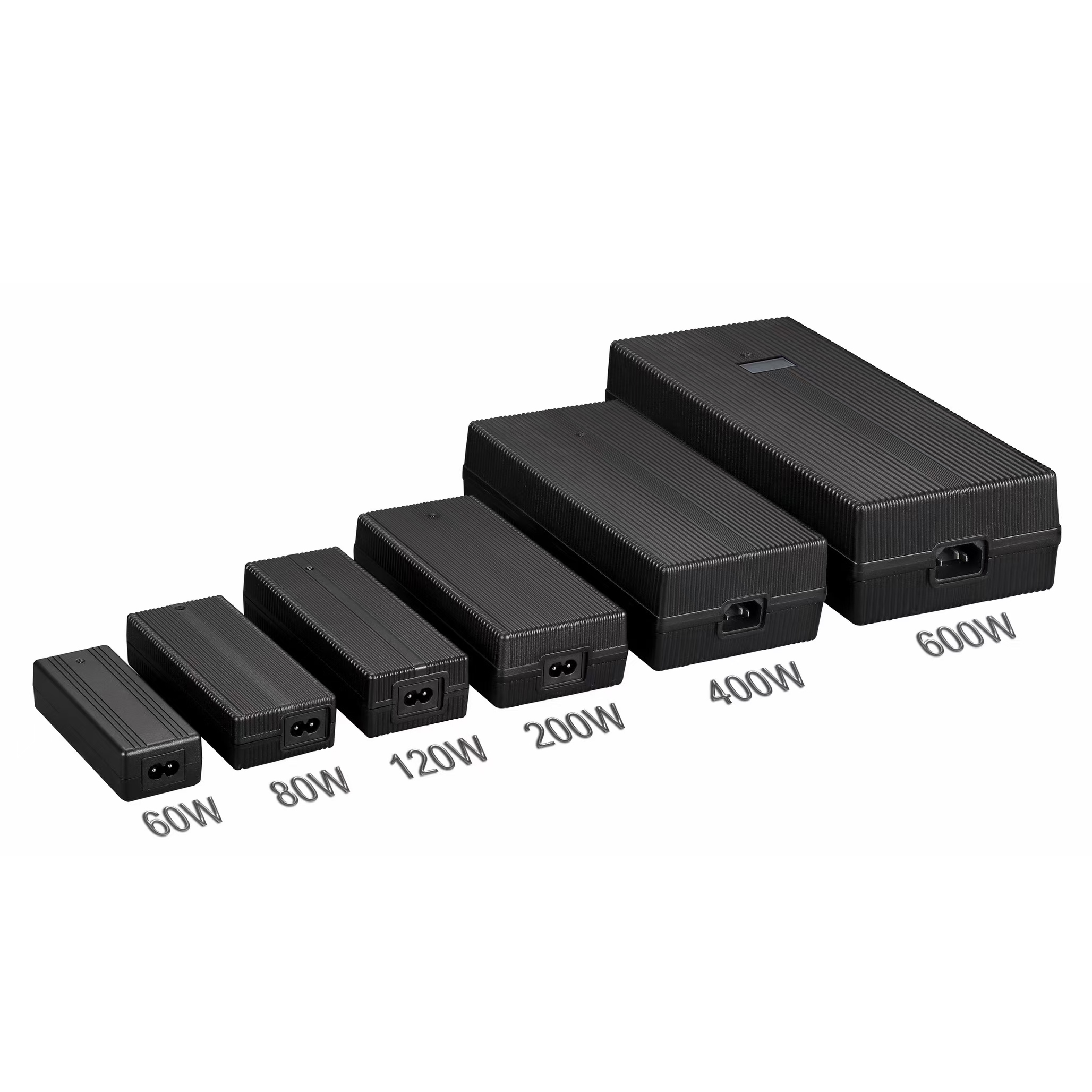
Multiply voltage by current, then add margin. A 54.6V/10A demand is roughly 550W, so a 600W unit holds full output through a hot afternoon instead of derating. The same pack charged at 1C (20A) needs about 1.1kW, which is why 1kW-class hardware exists in most industrial catalogues. A 10–20% margin covers cable drop, high ambient temperature and ageing capacitors.
Tip: Label every pack with its full-charge voltage, not its nominal figure. Maintenance teams that quote nominal voltage are the ones who end up with chronically half-charged batteries.
Industrial chargers fall into two output architectures. Fixed-output models are built for one pack voltage and make sense when a fleet standardises on a single battery. Adjustable models deliver a segmented 8V–87V output instead, which suits mixed fleets and service work.
A ±1% window on a 58.4V charge is ±0.58V, and that spread is the difference between a balanced pack and one where a weak cell drifts below its neighbours over hundreds of cycles.
Ripple is the other half of output quality. Noise below 1% of output keeps a BMS from misreading cell voltages and avoids the internal heating that eats into cycle life on high-current packs. On the input side, look for efficiency of 90% or better above 120W and confirm compliance with DoE Level VI or ErP Stage 2; both also cap no-load draw, which matters for a charger that stays plugged in.
Tip: Ask for the ripple figure in mV at full load. Noise measured at 20% load tells you very little about behaviour on a hot bench with the pack demanding maximum current.

AC-DC chargers rectify mains power through a PFC stage and a high-frequency transformer, which suits fixed charging points: a wall socket, a depot bay, a factory floor. DC-DC chargers skip the rectifier and condition 12–30VDC from a vehicle bus directly.
Mobile and off-grid duty is where the DC-DC route wins. One conversion stage instead of two means less loss to dissipate and less heat to manage inside a sealed enclosure, and the same output arrives in a smaller footprint — useful when the charger lives in a vehicle bay. A dedicated DC-DC converter also avoids the inverter losses that come with running mains-rated equipment from a 24V system.
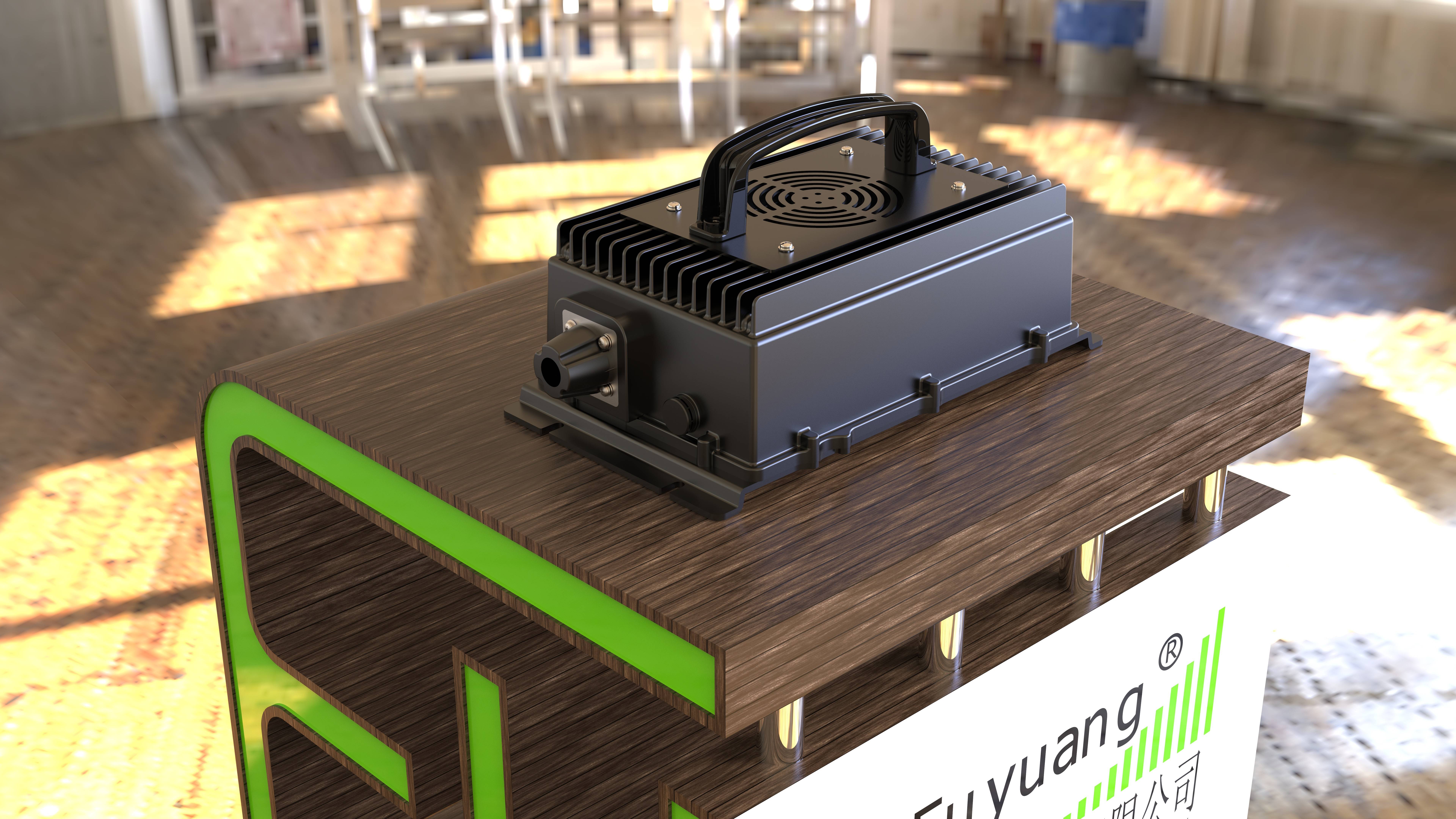
A 650W charger running at 95% efficiency still dissipates about 33W as heat; at 1kW the figure is roughly 50W. Fanless designs handle that with generous surface area, vertical airflow paths and, above a few hundred watts, aluminium housings. Two checks matter more than the spec sheet: continuous-duty rating at your ambient temperature rather than at 25°C, and whether the design depends on a fan whose intake will clog with dust.
Protection should be layered rather than software-only: output short circuit, overcurrent, overvoltage, over-temperature and reverse polarity, with fuses on both the input and output side as a physical backstop.
Tip: For mobile duty, verify reverse-polarity and transient protection on the input. Vehicle electrical systems produce spikes that a mains-oriented design was never asked to survive.
Certification maps directly to which markets a product can enter. Match the mark to the destination: UL/cUL or ETL plus FCC for North America, CE (EMC and LVD) and TUV-GS for Europe, UKCA for the UK, PSE for Japan, KC for Korea, SAA/RCM for Australia and New Zealand, CCC for China, BIS for India and NOM for Mexico. RoHS and REACH cover material compliance, and IEC 60601 expectations apply to anything that touches a medical device.
Verifying a supplier takes two more questions: does the factory test to the standards it claims, and can it prove it? An in-house EMC laboratory built to CNAS standards shortens certification cycles and catches emissions problems before an external lab does. On the quality side, ask for 100% factory inspection, a 4–8 hour full-load burn-in, an MTBF figure of 30,000 hours or better, and the warranty term.
Fuyuan Electronic, founded in 2005, builds chargers, adapters and LED drivers across a 60W–10KW range from two production bases totalling 108,000 m², with GaN and SiC designs at 120W, 240W and 330W reaching up to 95% efficiency and CAN 2.0 or RS485 available for remote monitoring.
Charger selection comes down to three numbers and one habit. Cells in series give you the full-charge voltage, capacity gives you the current, and the product of the two plus 10–20% gives you the power rating. The habit is checking the way the charger behaves at temperature and at full load, because that is where marginally rated units fail first. For reliable products and expert support, Fuyuan Electronic offers high-quality battery chargers engineered for continuous duty.
A: Multiply the number of cells in series by the full-charge voltage per cell — 4.2V for Li-ion, 3.65V for LiFePO4. A 13S Li-ion pack needs 54.6V and a 16S LiFePO4 pack needs 58.4V. Select a charger whose output range covers that figure, not the nominal pack voltage.
A: At 0.5C the pack wants 10A, which is about 550W at 54.6V; at 1C it wants 20A, roughly 1.1kW. Add 10–20% headroom, so plan on a 600W unit for standard charging or a 1kW-class unit for faster turnaround.
A: Yes, if it offers an adjustable or segmented output — for example 8V–87V — rather than a fixed voltage. Confirm the current rating at the highest voltage you intend to use, since output power stays the same while voltage rises.
A: A unit rated exactly at the calculated demand will derate or shut down once ambient temperature climbs or components age. A 10–20% margin keeps it in constant-current mode for the whole cycle and extends service life.
A: Choose AC-DC where mains power is available. Choose DC-DC when the source is a 12–30VDC vehicle or solar system, since one conversion stage instead of two cuts losses and reduces heat inside the enclosure.


