Views: 0 Author: Site Editor Publish Time: 2026-03-23 Origin: Site


A battery charger is a deceptively simple box with three jobs: convert mains or vehicle power into a voltage the pack can accept, manage the charge so the cells survive thousands of cycles, and meet the efficiency rules that apply in the destination market. Get all three right and it disappears into the product. Get the second one wrong and it becomes the reason a battery pack is replaced under warranty two years early.
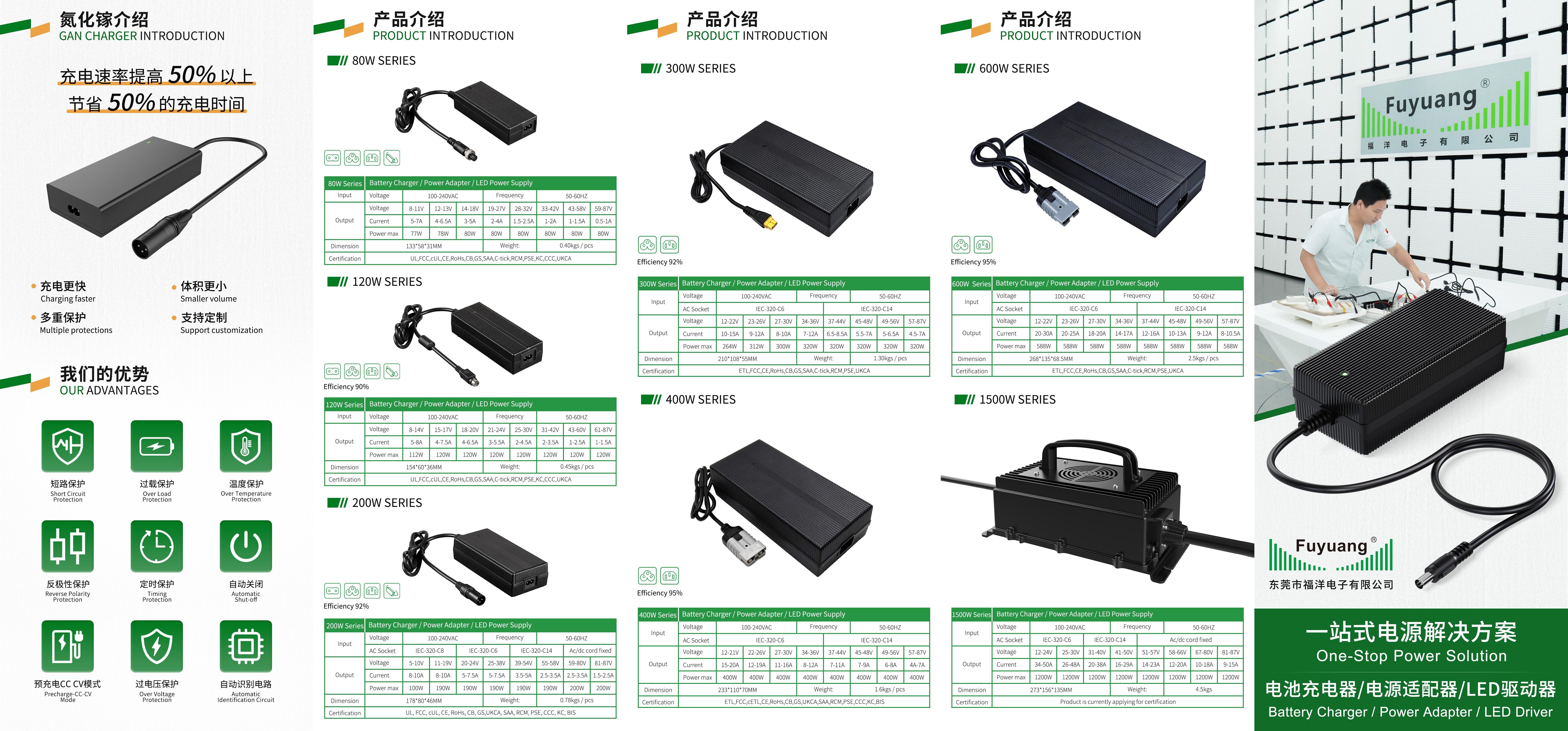
Conversion is the visible part. A charger turns 100–240 VAC mains, or a 12–30 VDC vehicle supply, into a regulated DC output — often adjustable across a wide window such as 8 V to 87 V — matched to the pack's chemistry and cell count.
Charge management is the part that determines pack life. Constant-current / constant-voltage profiles, temperature compensation, timer functions and automatic cutoff at full charge are what keep a lithium pack inside its safe operating window. Protection functions sit alongside them: short circuit, overcurrent, overvoltage, over-temperature, reverse polarity and, on units designed for it, a fuse on both the input and the output.
Efficiency compliance is the part that decides whether a container clears customs without an argument. CEC, DoE Level VI, Energy Star, ErP Stage 2, CoC Tier 2, NRCan and GEMS set standby power and average efficiency limits that vary by market and by power band.
The practical way to think about a charger catalogue is by power band, because the band determines the enclosure, the thermal approach and the certification route.
Power band | Typical loads | Structural notes |
|---|---|---|
60–150 W | Small battery packs, LED lighting, cameras, consumer devices | Wall-plug or desktop, plastic or aluminium, convection cooled |
200–400 W | Service robots, e-bikes, portable power stations, medical carts | Slim or standard housings, DC-DC variants, IP67 options |
600–1,000 W | AGVs, industrial trucks, multiple simultaneous packs | Dual or four-channel outputs, aluminium housings, forced-air or high-mass passive cooling |
1,500–3,000 W | Heavy mobile equipment, fast charging on larger packs | IP67 enclosures, high-current connectors, CAN or RS485 control |
Above 3 kW | Non-standard industrial and infrastructure projects | Custom development route |
Buyers who select by model number end up with a charger that fits one product. Buyers who select by band, and then ask which output windows a family covers, end up with a platform that follows their product roadmap. Adjustable output is the mechanism here: a wide window means one design can serve a 24 V pack this year and a 48 V pack next year without a new certification cycle.

Fuyuan Electronic covers 60 W to 10 kW across three product lines — battery chargers, power adapters and LED drivers — and has developed more than 3,000 models since 2005. That kind of span is unusual in a single supplier, and it is the reason a light-mobility charger and a 3 kW industrial unit can arrive from the same factory with the same test regime behind them.
Tip: Ask which output windows are already tooled. A window that exists costs nothing to specify; a new one adds engineering time and a fresh certification run, whether or not the power rating is the same.
IP67 is the entry point for outdoor, wash-down and high-humidity environments. It is achieved through double sealing at the mating faces, potted or coated circuit assemblies and sealed cable entries, not by a gasket alone. Aluminium housings handle both the sealing and the mechanical abuse that a plastic enclosure will not survive — a charger mounted on a moving machine sees vibration that a desktop unit never will.
Operating range is worth reading carefully. A charger specified from −29 °C to +45.5 °C operating and −40 °C to +75 °C storage will cover most outdoor deployments in Europe and North America, but a unit that never leaves a temperature-controlled factory does not need to pay for that headroom. Wide-range versions exist for cold-chain, outdoor LED and agricultural applications.
Beyond the standard protection set, two design details separate domestic products from industrial ones: whether both input and output are fused, and whether the unit restarts predictably when mains power returns after an outage. On multi-output chargers, independent channels matter as well — a fault on one channel should not take the others offline.
Tip: Ask how the charger behaves after a power interruption with a full pack attached. Chargers that resume constant-voltage charging on a full pack are a quiet source of heat damage in unattended installations.
Charger demand has moved well beyond consumer electronics. Five application groups account for most of the growth in the 60 W to 10 kW band.
Light electric mobility: e-bikes, e-scooters, balance boards and light motorcycles, typically 24 V to 72 V packs with 2 A to 10 A charge currents.
Battery packs and storage: three-stage charging profiles with temperature compensation tuned to lithium-ion, LiFePO4 and lead-acid chemistries, plus capacity retention across repeated cycles.
Robotics and automation: continuous-duty charging for AGVs and service robots, with dual-output designs and CAN 2.0 or RS485 links into fleet controllers.
LED lighting and outdoor systems: sealed drivers that must survive condensation and heat cycling, with power factor correction to meet European design requirements.
Communications and IoT: low-ripple outputs that do not interfere with RF equipment, and standby power low enough to satisfy the current efficiency rules.
Tip: Group purchases by application rather than by power rating. Two chargers in the same band can need very different duty cycles — one cycling daily, one running continuously — and the specification should follow the duty cycle, not the wattage.
The supplier question comes down to control over three things: design, test and certification.
Design depth shows up in details such as GaN and SiC adoption. Fuyuan produces GaN and SiC designs at 120 W, 240 W and 330 W with efficiency up to 95%, which is how the same output power fits into a smaller case. Test depth shows up in the laboratory: an in-house CNAS-standard EMC laboratory allows pre-compliance testing before a design goes to an external body, shortening certification cycles and reducing the risk of a failed submission. Certification depth shows up in the market list — UL, cUL, ETL, FCC, TUV-GS, CE, CB, UKCA, PSE, KC, KCC, SAA, RCM, CCC, NOM, BIS, RoHS and REACH.
On the commercial side, the numbers that matter most are the ones that shape a launch plan: OEM and ODM projects with design-to-engineering turnaround as fast as ten days, a minimum order quantity of 100 units, 4–8 hours of full-load burn-in with 100% factory inspection, a 3-year warranty and an MTBF of 30,000 hours or more. Manufacturing runs from two production bases in Dongguan and Yongzhou covering 108,000 m², with 450 employees and ISO9001, ISO14001, QC080000 and BSCI certification behind the paperwork.
Choosing a charger is mostly a matter of asking the right questions early: which output window, which ambient conditions, which duty cycle, which market certifications, and how much of the design the supplier actually owns. Those answers determine cost, certification time and field reliability more than the headline wattage ever will. For reliable products and expert support, Fuyuan Electronic offers high-quality battery chargers, power adapters and LED drivers from 60 W to 10 kW, backed by an in-house EMC laboratory, global certification and a 3-year warranty.
A: Fuyuan produces battery chargers from 60 W to 10 kW across more than 3,000 developed models. Standard families cover 60 W through 3,000 W, and projects above that are handled through the custom development route.
A: Yes, but the charge profile has to be tuned per chemistry. Lithium-ion, LiFePO4 and lead-acid packs need different top-of-charge behaviour, and a charger configured with the wrong profile will shorten pack life even when every electrical rating matches.
A: Dust-tight sealing and protection against temporary immersion. It suits outdoor equipment, wash-down areas and humid plants. It does not replace proper cable entries and connector protection, so the installation matters as much as the enclosure rating.
A: Design to engineering sample in as little as ten days for ODM projects, starting from a minimum order quantity of 100 units. Functional customization, private labelling and logo printing are all handled in-house, alongside connector and cable assembly.
A: Request certification for the exact model and the markets you ship to: UL, cUL or ETL for North America; CE with TUV-GS and CB for Europe; UKCA for the UK; PSE for Japan; KC for Korea; SAA and RCM for Australia and New Zealand; CCC, NOM and BIS where applicable; and RoHS plus REACH declarations for materials.


