Views: 0 Author: Site Editor Publish Time: 2026-11-05 Origin: Site


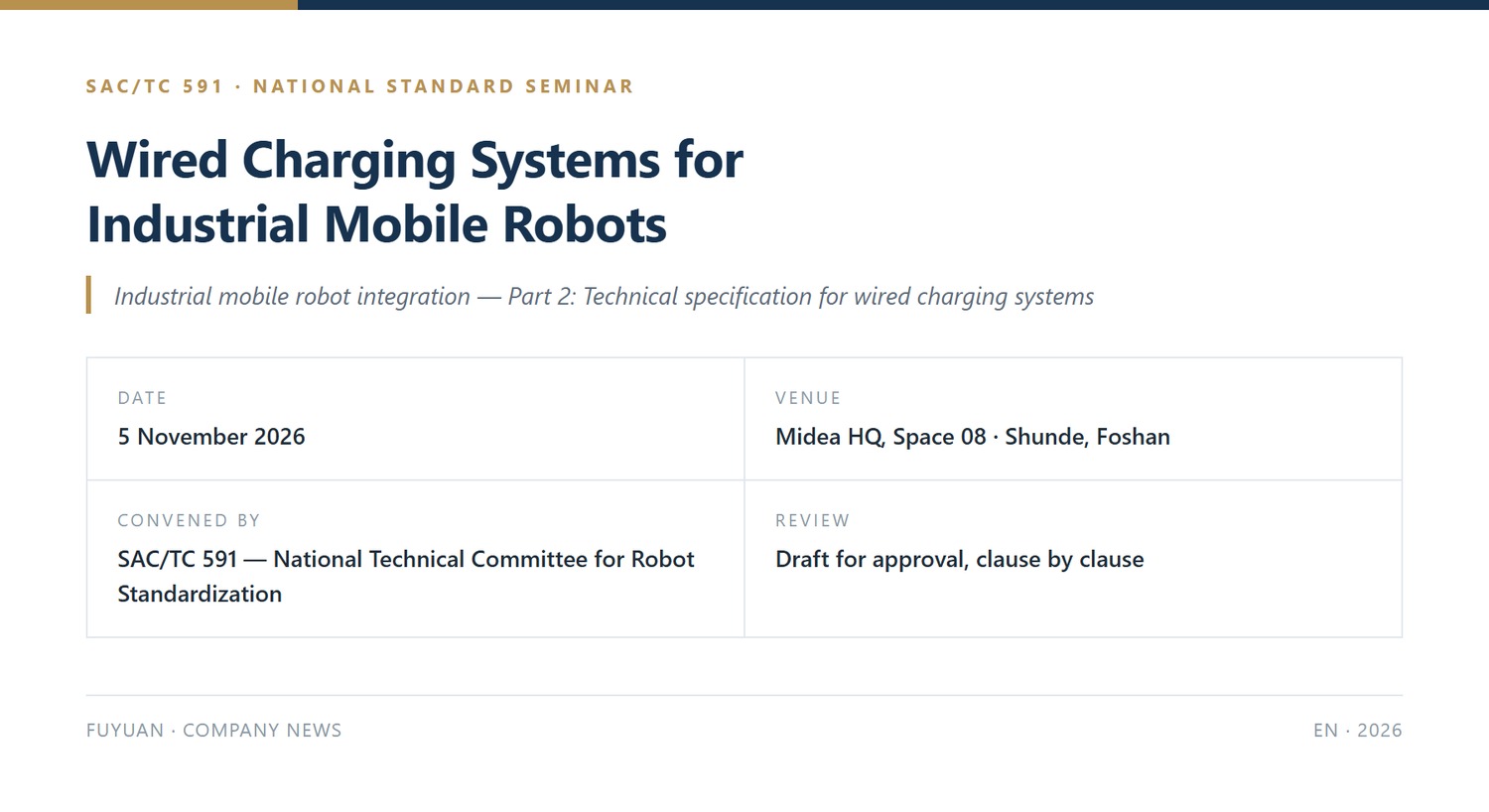
On 5 November 2026, SAC/TC 591, China’s National Technical Committee for Robot Standardization, held the seminar on Industrial mobile robot integration—Part 2: Technical specification for wired charging systems at Midea headquarters in Shunde, Foshan. Drafting-unit representatives, standards experts and industry technical leaders reviewed the draft for approval clause by clause.

Dongguan Fuyuan Electronic Co., Ltd. (FUYUAN ELECTRONIC CO., LTD, “Fuyuan”), a national high-tech enterprise and Guangdong SRDI SME, was invited. General Manager Huang Shaocheng took part throughout, drawing on more than 20 years of high-power industrial charging, BMS interaction, electrical safety and CNAS-standard EMC work to propose amendments and supply technical support.
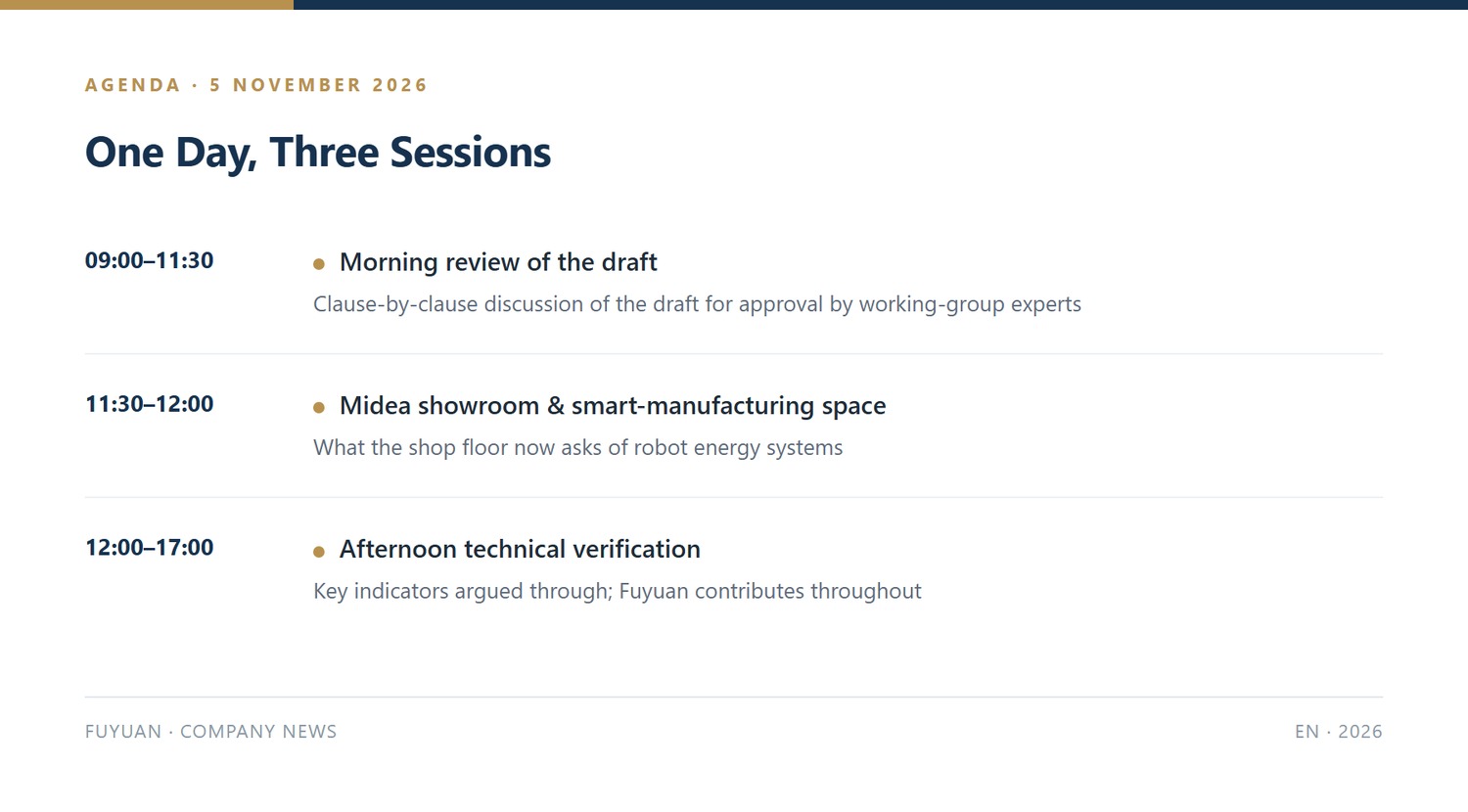
Per the SAC/TC 591 notice, the day ran from a morning review of the draft to a visit of Midea’s showroom and smart-manufacturing space, then an afternoon of clause-by-clause verification of key indicators.
AGVs, AMRs, composite and embodied-intelligence robots are now a core engine of smart manufacturing. From automotive assembly and 3C precision workshops to lithium-battery plants, automated warehouses and cross-site logistics, deployment density and duty cycles keep climbing. Behind round-the-clock unmanned operation, the wired charging system is both energy hub and safety gatekeeper.

Growing payloads, larger batteries and fast charging expose the same gaps: vendor-specific interfaces and parameters, limited charger-to-BMS compatibility, no standard for arc protection or temperature rise at high current, frequent EMI in industrial grids, and no common yardstick for reliability under extreme temperature, dust and humidity. These raise deployment and maintenance costs, and bear directly on site safety.
The standard therefore carries milestone weight: unified national requirements for performance, safety, communication, test methods and inspection give the supply chain an authoritative reference.
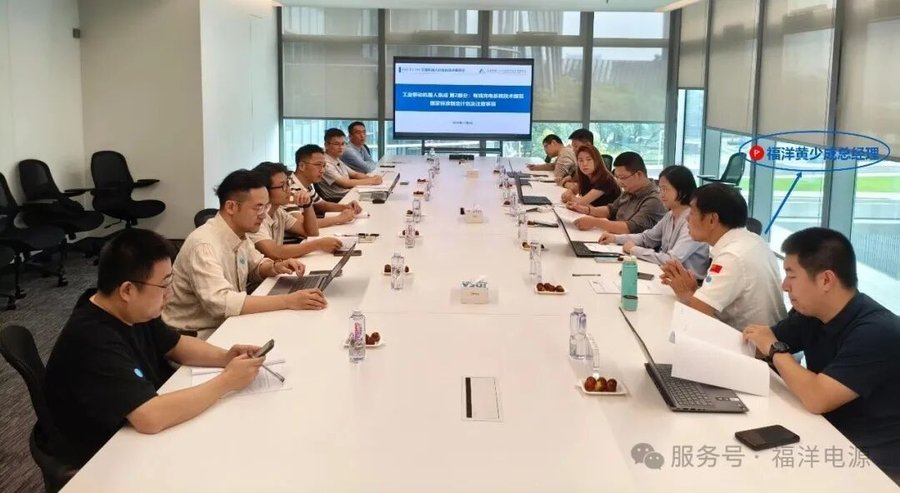
The review was thorough and hands-on. Working-group experts went through the draft article by article, and Fuyuan’s General Manager added a pragmatic, professional voice to a dialogue that sets the bar for robot charging in China.
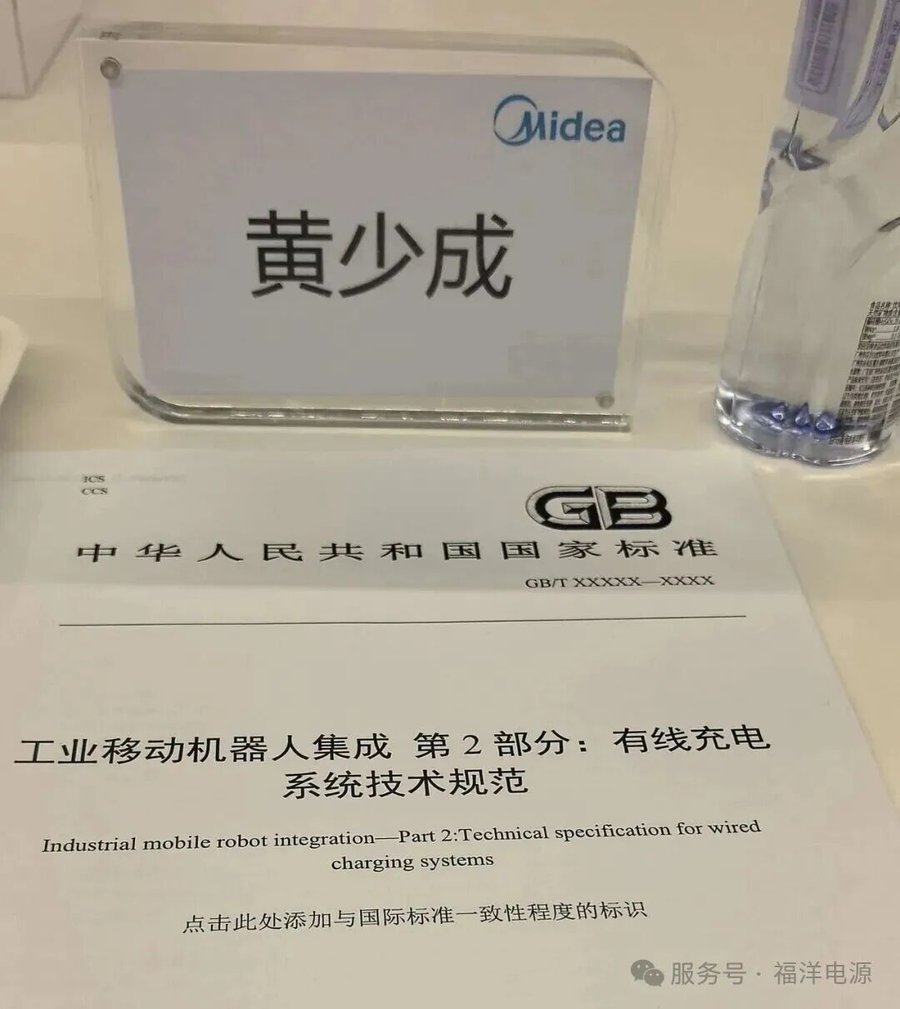
Copies of the draft lay open on the table. Every indicator defined and every test method weighed will shape where China’s industrial mobile robot industry goes next.
Representing a manufacturer with more than 20 years in power and intelligent charging — and with practice built on 3,000-plus power supply models and service to dozens of leading robotics and smart-equipment companies — the General Manager offered forward-looking, workable proposals on the core technical chapters, backed by laboratory data.
In autonomous navigation and automatic docking, a wired charger is not an isolated converter but an intelligent node exchanging data with the robot controller and BMS. The standard, he argued, should stress intelligent sensing and active safety interaction during charging.

Fuyuan’s production logic runs a full cycle. On connection, the charger identifies battery voltage and polarity, avoiding the short-circuit surge of reverse connection. In constant-current and constant-voltage stages, high-precision temperature sensing and real-time current locking adjust power when temperature rises abnormally. At full charge, it steps down and cuts off automatically, with timed charging as redundancy. Over CAN 2.0 and RS485, live voltage, current, internal temperature and status reach the plant scheduling system, making unmanned charging visible, controllable and traceable. Experts endorsed the proposal.
High-power charging under frequent mating, load transients and grid fluctuation invites hazards. Because robots work beside people and high-value equipment, the General Manager argued for a zero-accident rule in the safety chapter.
Fuyuan proposed a full-chain reference drawn from its own internal standards: dual fuses at input and output for physical isolation and fast cut-off under extreme faults, plus nine-layer hardware and software protection — short circuit, overcurrent, overvoltage, overtemperature, reverse connection, automatic cut-off at full charge and timed charging, among others. For LiDAR, cameras and compute boards that need clean power, it recommended low ripple and fine output adjustment to keep transients out of the robot’s low-voltage systems.
Robots now work in cold northern warehouses, hot and humid southern workshops, outdoor ports and dusty lines, far from climate-controlled plants. In the environmental and reliability session, the General Manager shared Fuyuan’s approach to extreme conditions.
The team recommended pairing wide-temperature thermal design with enclosure protection: thermal simulation and fanless free convection remove fan wear and dust ingress while holding −29 °C to +45.5 °C operation and −40 °C to +75 °C storage; wet, dusty and outdoor modules use a rugged aluminium housing sealed to IP67. On reliability, Fuyuan offered its own regime — MTBF of 30,000 hours or more, four to eight hours of full-load burn-in and 100% outgoing inspection.

Inverters, servo motors, wireless base stations and several robots run at once on an automated floor. A charger must not pollute workshop wireless and navigation signals (EMI), and must withstand harmonics, surges and electrostatic discharge (EMS). From Fuyuan’s in-house CNAS-standard EMC laboratory, the General Manager shared measured data across power ranges — conducted and radiated emissions, harmonics, ESD, surge and fast transients — helping the group calibrate limits and test configurations.

The invitation rests on more than 20 years of consistent work in power and charging technology.
Two bases and 108,000 m² of manufacturing, with national high-tech and provincial SRDI recognition.
Founded in 2005, Fuyuan (with Hunan Fuyuan Electronic Co., Ltd.) develops and manufactures battery chargers, power adapters and LED drivers, and holds National High-Tech Enterprise and Guangdong SRDI SME status. Plants in Dongguan, Guangdong and Yongzhou, Hunan total 108,000 m², with 450 employees, automated clean rooms and ISO 9001, ISO 14001, QC 080000 and BSCI certification.

A 36-year chief engineer, 60W–10KW coverage and GaN/SiC leadership.
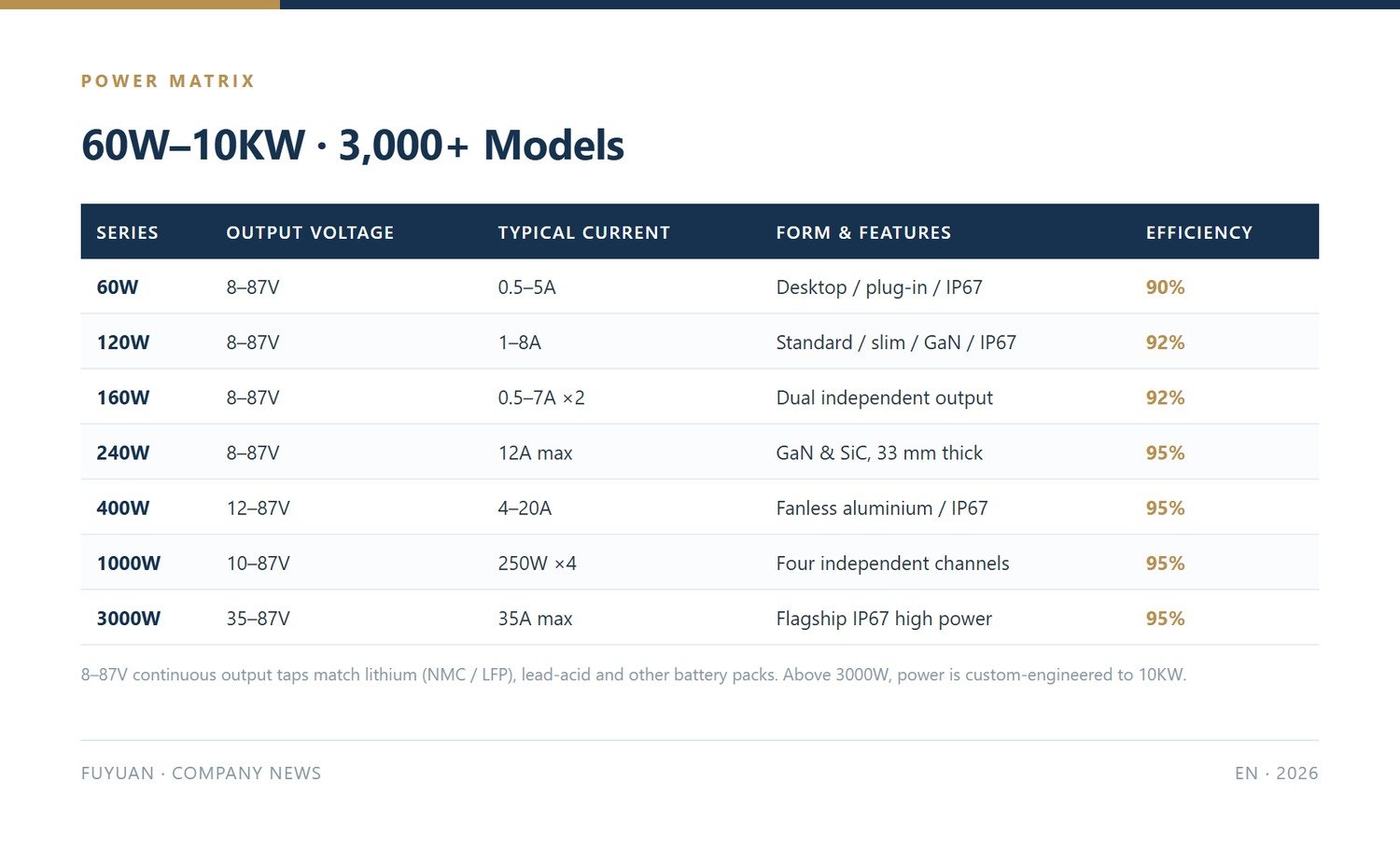
A chief engineer with 36 years in the industry leads R&D across concept, engineering and volume ramp; custom products can reach engineering in 10 days. Coverage runs 60W–10KW across 3,000-plus models, with the 120W–10KW range as the core moat:
· Third-generation semiconductors: GaN/SiC in 120W, 240W and 330W series, at up to 95% conversion efficiency.
· Multi-channel independent output: 160W dual-output and 1,000W four-output designs that do not interfere, for multiple battery packs and fleet charging.
· Industrial high-power matrix: proven at 1,500W and 3,000W (35–87V / 35A max, 95% efficiency) and up to 10KW on custom projects, with 15 AC plug types and 35 industrial DC connectors (aviation plug, XT60/XT90, Anderson and others).
In robotics and smart equipment, Fuyuan serves Unitree, AGIBOT, UBTECH, PUDU, YUNJI, DREAME, iRobot and TENNANT, and 28+ global brands including Huawei, Lenovo, LG, BYD, Toyota, ZTE, Everwin Precision, Sunwoda, EVE Energy and EHANG. The range meets global efficiency standards and holds UL, cUL, ETL, FCC, TUV/GS, CE, CB, UKCA, SAA, RCM, PSE, KC, CCC, NOM, BIS, RoHS and REACH, with a 3–5 year warranty.
First-class companies write the standards. Speaking for Fuyuan, proposing amendments and supplying test data, the General Manager’s participation marks recognition by the national standards body and by industry peers — a step from power supply manufacturer to co-author of a national industry standard.
Fuyuan will hold to its mission: to benefit humanity, pursue environmental protection and commercial growth together, and serve global customers with ultimate reliability and safety. With standard work as a new starting point, it will keep investing in industrial mobile robots, embodied humanoid robots, the low-altitude economy and smart energy.
Dongguan Fuyuan Electronic Co., Ltd. and Hunan Fuyuan Electronic Co., Ltd. (FUYUAN ELECTRONIC CO., LTD) form a national high-tech enterprise and Guangdong SRDI SME focused on battery chargers, power adapters and LED drivers from 60W to 10KW, with in-house R&D and manufacturing, global certifications and a 3–5 year warranty. Dongguan headquarters: No. 25, Sanjiang Industrial Zone, Hengli Town, Dongguan, Guangdong, China. Hunan base: Room 2-102, Building 3B, Shunyang Avenue, Dongxi Street, Ningyuan County, Yongzhou, Hunan, China.


